

Coffee Decoded: Can We Smell Sweetness?
Welcome to Coffee, Decoded, the Specialty Coffee Association’s weekly column on science, research, and all things coffee knowledge. Each week, PETER GIULIANO answers complex coffee questions, interprets new research, and dives deep into the science, putting it all in a fun, understandable format.
When I first learned to taste coffee professionally, I was taught that sweetness in coffee was important—the cupping form had a whole section dedicated to it—and that sweetness was something you tasted.
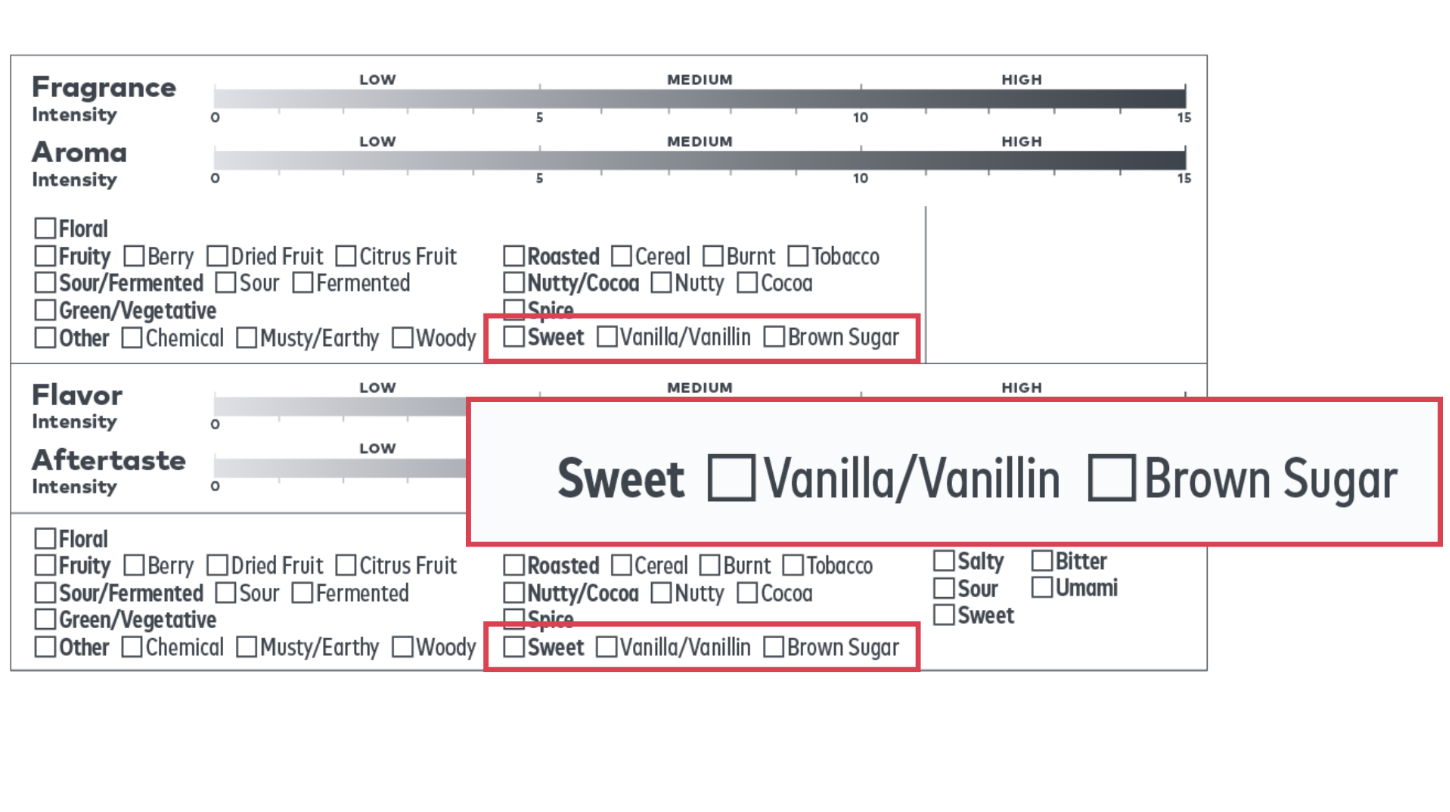
“Sweet” appears as a descriptor in both the Fragrance/Aroma and Flavor sections of the CVA Descriptive Assessment.
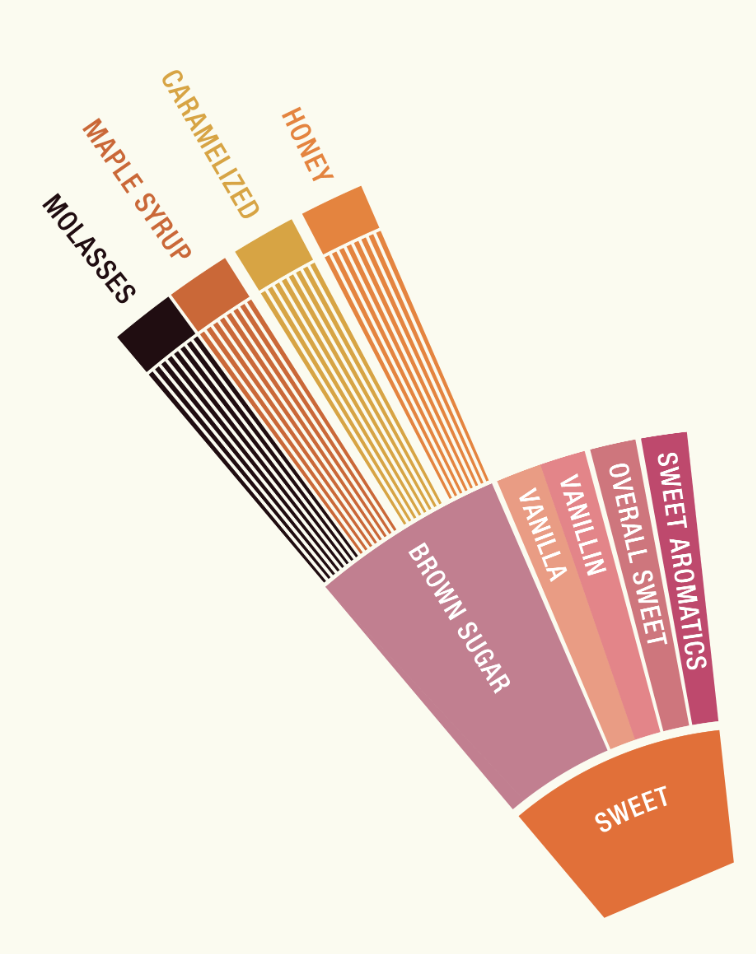
The “Sweet” section of the Coffee Taster’s Flavor Wheel, developed by the Specialty Coffee Association, World Coffee Research, and UC Davis.
Some cuppers, however, used the term “sweet aromatics” to describe a sweet smell. Others objected: sweetness was a taste, not a smell.
This question about sweetness being a taste or a smell became something of a controversy in coffee-tasting circles. But what’s the answer? Can sweetness be smelled or not? Can science help shed light on this question?
As children, we all learn that we have five senses: touch, smell, sight, hearing, and taste. And each sense has a corresponding bodily system: our eyes give us the sense of sight, our ears give us the sense of hearing, our skin gives us touch, our noses give us smell, and our tongue gives us taste. So far so good. And our sense of taste can be broken down into five stimuli: sour, bitter, salty, umami, and sweet.
Problem solved—right? We taste sweetness on our tongues. To say we “smell” sweetness is a category error, like saying we can hear “yellow” or “see” music.
The above was the orthodox view for decades. Senses—called “modes of perception” in the scientific literature—were cleanly separated and did not mix. However, a few decades ago, cracks in this orthodox view began to emerge. In the arts especially, people have always had the idea that senses might be linked. We have expressions like “feast for the eyes” or “a sweet sound” that suggest a connection between senses. And so, neuroscientists such as Charles Spence at Oxford University in the UK started to investigate.

The Bouba/Kiki effect describes how study respondents around the word tend to associate hard sounds (“kiki”) with spikey shapes, and soft sounds (“bouba”) with round shapes. Many researchers have extended this phenomenon to our other senses—soft colors and shapes are more likely to increase perceptions of sweetness and softness, spikey shapes of acidity.
These scientists began to prove experimentally that our intuition is correct, that sometimes we can perceive things using multiple senses. Cognitive scientists began documenting phenomena that crossed sensory modalities, such as the Bouba Kiki Effect and the McGurk Effect. In 2013, researchers gave the field a name: Crossmodalism. This new field was dedicated to the idea of studying sensory phenomena across sensory modalities, not just within them.
So, can we smell sweetness? In 2022, the Coffee Science Foundation set out to find the answer.
Working with researchers from The Ohio State University, we designed a set of experiments aimed at thoroughly exploring the phenomenon of sweetness in coffee. The research is complex and ongoing- but excitingly, the early outcomes were clear: sweetness in coffee is real, and it is perceived both as a taste and as a smell.
This shouldn’t be surprising. The smells of caramel, vanilla, and fruit are associated in many foods with sugary tastes, so our brain makes strong connections between those aromas and the “sweet” sense. And all of these aromas can be present in coffee. Coffee can be deliciously fruity, or redolent of brown sugar and vanilla. It makes sense that perception of those aromas would lead to a coffee being described as “sweet.”
The smells of caramel, vanilla, and fruit are associated in many foods with sugary tastes, so our brain makes strong connections between those aromas and the “sweet” sense. And all of these aromas can be present in coffee.
And it gets even better: the same team that proved the phenomenon of sweet aromatics has gone on to identify some of the chemical compounds that drive it. This means that, not only are coffee tasters right when they describe a coffee as “sweet-smelling”, that we will be able to show exactly which compounds cause it.
And that, friends, is a pretty sweet outcome.
- PETER GIULIANO is the SCA's Senior Advisor for Scientific Communication.
Want to learn more?
Read
How Sweet Coffee Tastes!
In 25, Issue 22 researchers Dr. NANCY CORDOBA and Dr. DEVIN PETERSON, joined by PETER GIULIANO, share early results of a multi-year Coffee Science Foundation research project, undertaken at the Flavor Research and Education Center at Ohio State University, to establish foundational knowledge about the phenomenon of sweetness in coffee. Accessible via the SCA Member Portal.
Watch
Sweetness in Coffee: Sensory Analysis and Identification of Key Compounds
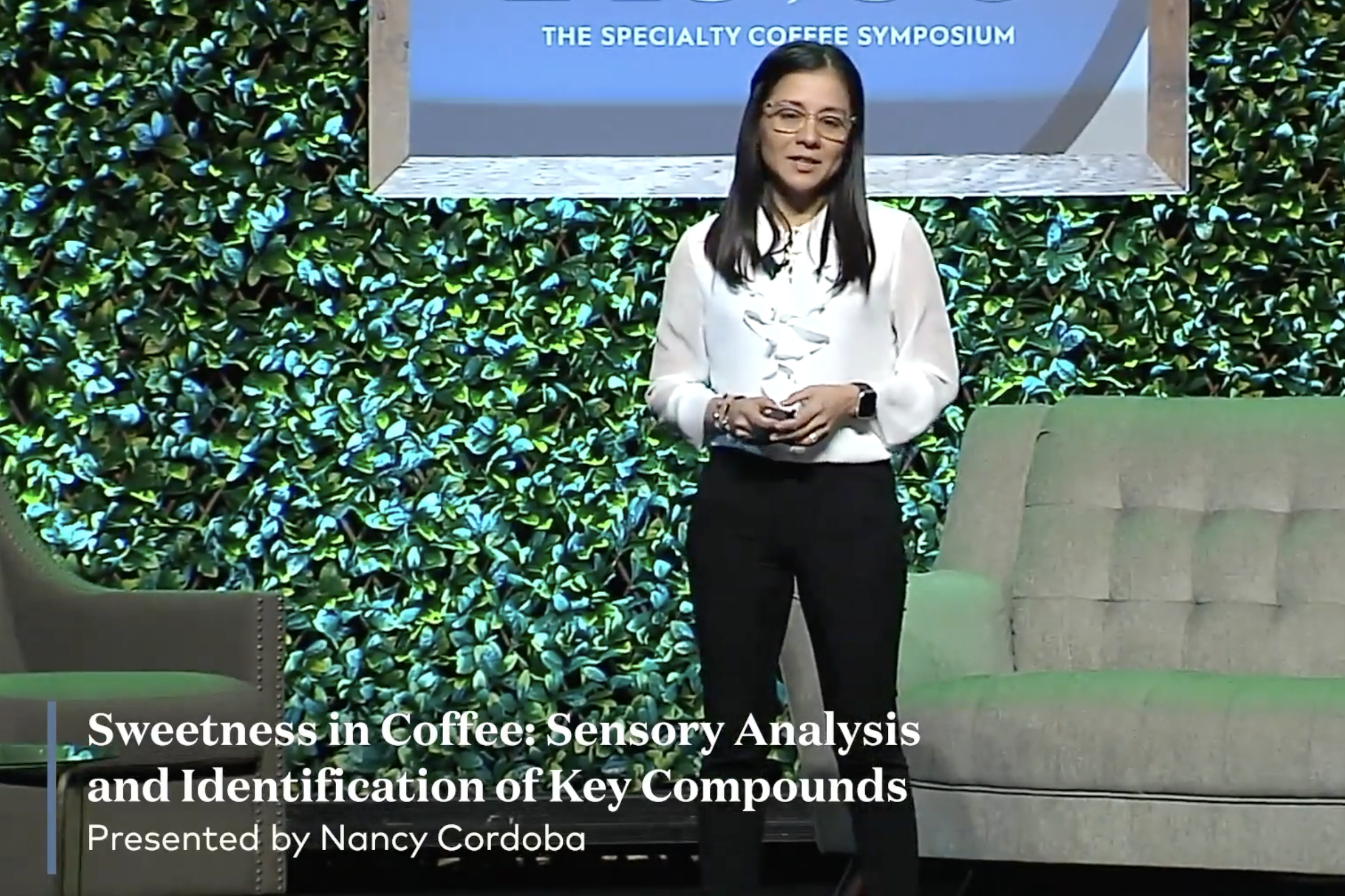
Dr. Nancy Cordoba discusses research that confirmed that, counterintuitively, the sweetness in coffee does not come from sugars in the bean. This has created something of a mystery among coffee experts and sensory scientists —if sugars do not make coffee taste sweet, what could be the reason for the sweet taste of high-quality coffee?