Building Psychological Safety in Specialty Coffee: A Systems Thinking Approach
DAPHNE ALLISON a registered Associate Marriage and Family Therapist and former coffee professional, shares practical insights into how to build psychological safety in specialty coffee workplaces—and why it’s so important.
Personal Reflection
I come to this topic as someone who has worked behind the bar for nearly a decade and as a recently- graduated marriage and family therapist training in systems thinking. My perspective is shaped by my identity as a U.S. based, Hispanic, female professional, and by how that identity intersects with the context of specialty coffee. These lenses inform how I think about psychological safety—not as an abstract management trend, but as a lived practice of relational responsibility, where well-being and accountability emerge from the relationships and contexts we share, not just from individual effort.
As I think about my experience over the years, I often wonder: what does it really take to create an environment where everyone feels safe to speak up, learn, and thrive? How can we make these often-invisible dynamics something we can actually see, talk about, and shape? I offer these questions not as conclusions, but as invitations. My hope is that this reflection sparks your own questions too—about what safety looks like, how it feels, and what supports or threatens it in your setting. Both shared experiences and differences can be valuable starting points for thinking about what psychological safety means in your corner of the coffee sector. To explore these questions more concretely, it helps to define the concept of psychological safety and consider how it emerges in systems of relationships.
Defining Psychological Safety and Systems Thinking
The term psychological safety, coined by organizational scholar Amy Edmonson in the 1990s,[1] refers to a shared belief that a team is safe enough to take risks without fear of negative consequences. In practice, it means people feel comfortable saying, “I messed up that roast,” or “I think this workflow feedback isn’t effective,” without worrying about invalidation or pushback. When teams have this safety, people learn faster, share ideas freely, and build trust.[2]
From a systems perspective, psychological safety isn’t just about individual trust—it emerges from the patterns of communication and relationships that make up a workplace. People aren’t isolated; they exist within networks that continually shape one another. Cafe teams, warehouse crews, and even the broader structures mapped in the Specialty Coffee Association’s (SCA’s) Coffee Systems Map all have their own unspoken rules, norms, and power dynamics. These invisible systems influence how people feel, behave, and engage. Safety, then, is not created by any single person—it’s produced by the interactions across the system they’re a part of.
Why It Matters in Context
Psychological safety matters in every corner of the coffee industry—from cafés and farms, to roasteries or processing mills—because our work is powered by people. People do their best work when they feel respected, safe, and valued.[3] Yet, mental and emotional health in coffee workplaces is often overlooked, affecting employee retention, product quality, and customer experience. Psychological safety addresses this gap, turning well-being into action: helping people learn, take risks, and thrive.
The current under-recognition of psychological safety does not exist in a vacuum. Coffee’s global history is inseparable from systems of oppression that created enduring patterns of power imbalance and marginalization. Today’s workplaces may not replicate these conditions, but the industry still carries cultural and structural echoes of unequal power—where speaking up—particularly for underrepresented voices—often carries risk.
Psychological safety is more than an upgrade to an individual management skill—it’s a collective responsibility.
Using the concept of relational responsibility from communication and relational theorists Sheila McNamee and Kenneth Gergen,[4] we can understand the obligation to repair these inequities as arising not from individuals alone, but from the structures, relationships, and contexts we share. Through this lens, psychological safety is more than an upgrade to an individual management skill—it’s a collective responsibility. It helps us move from patterns of exclusion toward equity, turning care for people into care for sustainability. Workplaces that prioritize psychological safety align their practices with our industry’s values, honoring every voice, creating opportunities for repair, and supporting the well-being of all who make coffee possible.
The Business Case for Psychological Safety
Some might ask why they should change how they lead just to make others “feel good.” The answer is simple: unsafe team interactions aren’t just a morale problem; they create real business risks. Organizations lose insight, innovation, and opportunities to prevent costly mistakes.[5] Over time, these dynamics also contribute to burnout, causing disengagement, higher turnover, and lower-quality work. Importantly, psychological safety isn’t about lowering the bar—it’s about giving people the confidence to speak up, learn, and solve problems together so the team can meet high standards.
Building psychological safety asks for reflection: an honest look at how our choices, habits, and communication shape the systems we’re a part of.
In coffee, that looks like a barista noticing a recurring machine issue and alerting the team before it affects service, a roaster flagging a potential profile inconsistency so it can be corrected, or a green buyer sharing concerns about a sourcing risk that could impact quality. Psychological safety protects both people and businesses, reducing blind spots that can limit growth, quality, and sustainability. But awareness alone isn’t enough. Even well-intentioned leaders can unintentionally reinforce the very patterns they hope to change. Building psychological safety asks for reflection: an honest look at how our choices, habits, and communication shape the systems we’re a part of.
Leadership Shapes Safety
Within every workplace, people influence and are influenced by those around them—but some roles carry particular weight in shaping these dynamics. Leaders set the tone: by modeling openness and valuing input, they can create climates where people feel seen, heard, and supported. Recognizing this influence reminds us that fostering psychological safety is everyone’s responsibility, but leaders have a distinct role in making it possible.
These dynamics often show up in everyday moments. A barista may hesitate to challenge a café owner’s decision, not because they lack conviction, but because speaking up feels risky. Leaders who notice and respond—by inviting feedback, listening without defensiveness, and following up—create environments where voices matter, risks can be safely taken, and collective engagement grows. In this way, leadership is not about authority or control; it is marked by accountability. Every decision a leader makes carries the responsibility to recognize the impact of actions on both relationships and the broader system. [6] By embracing this responsibility, leaders foster conditions where teams can flourish and where the organization they’re a part of becomes more adaptable and resilient.
Reflective Leadership
Accountability begins with awareness. Reflective leaders pause to consider how their influence shapes others’ experiences and choices. Roles with greater weight—those responsible for people, training, resources, or purchasing decisions—carry the power to expand opportunities for others or restrict them.
One way to practice this reflection is to ask:
|
What role am I playing in this system? |
(e.g. am I a stabilizer, avoider of conflict, or a catalyst for change?) |
|
How am I shaping the "rules" of interaction? |
(e.g. do I model or reinforce openness, or punish dissent implicitly?) |
|
How do my actions constraint or expand the options others feel they have? |
(e.g. do I encourage exploration, or does my lack of response signal that only one approach is acceptable?) |
Reflection turns awareness into action. When leaders take responsibility for their impact, especially in moments of tension or uncertainty, they model the very openness and humility that psychological safety depends on. This kind of reflection does not weaken authority but deepens it, grounding leadership in relational trust. In a fast-paced, high-margin industry, reflective leadership sustains both people and performance—not through control, but through connection.
The Feedback Loop of Psychological Safety
In systems thinking, a feedback loop is a repeating cycle where one action affects the next, which then circles back to influence the first. Every team interaction sends signals that shape behavior, creating patterns that build or inhibit psychological safety. Observing these loops helps leaders spot opportunities for improvement.
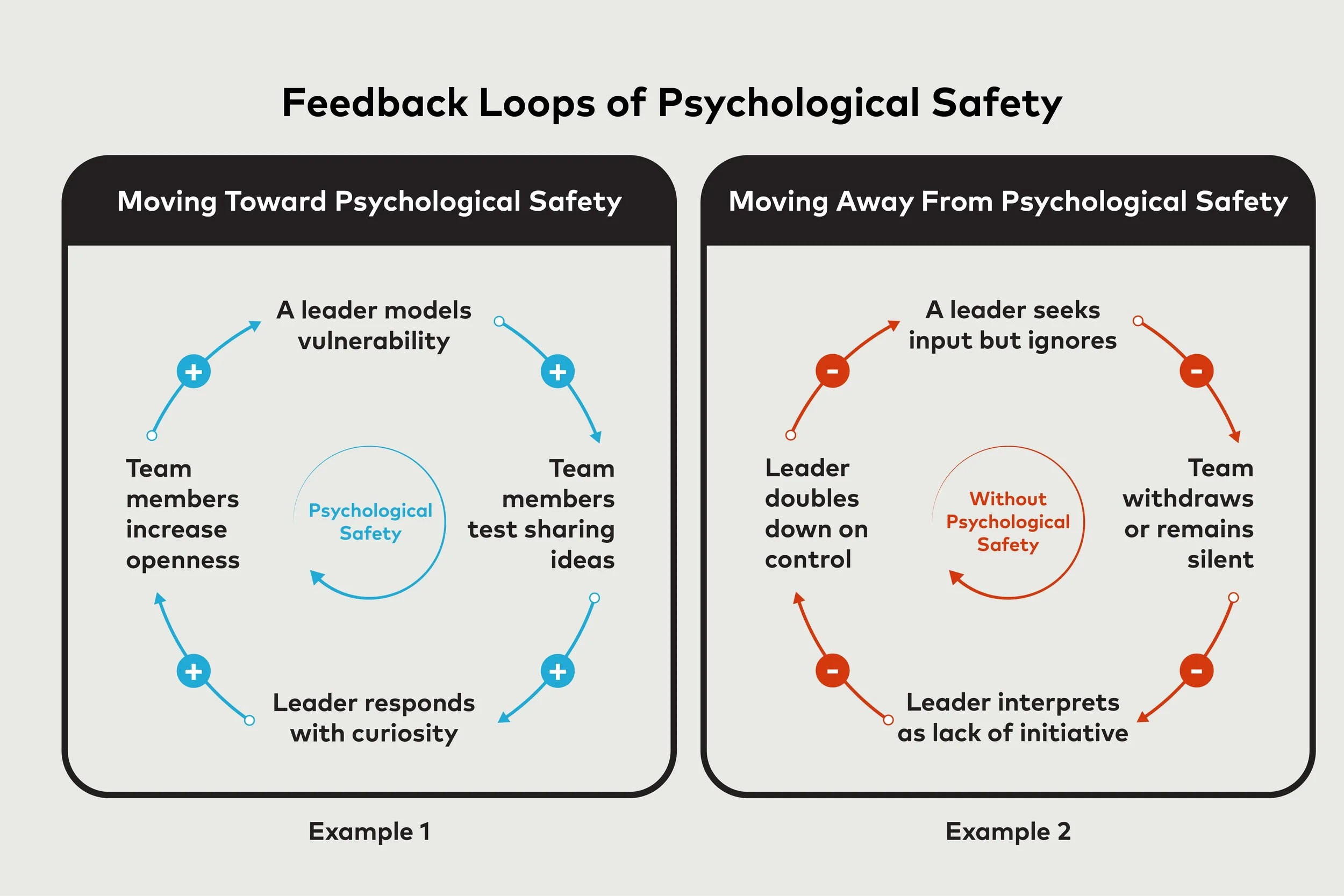
Example #1: A leader models vulnerability, encouraging team members to test sharing ideas. The leader responds with curiosity rather than finality or dismissal. This can result in team members increasing openness and the loop strengthens collective psychological safety.
Example #2: A leader solicits input but ignores it → team members withdraw → leader interprets withdrawal as lack of initiative → leader doubles down on control → the loop augments silence.
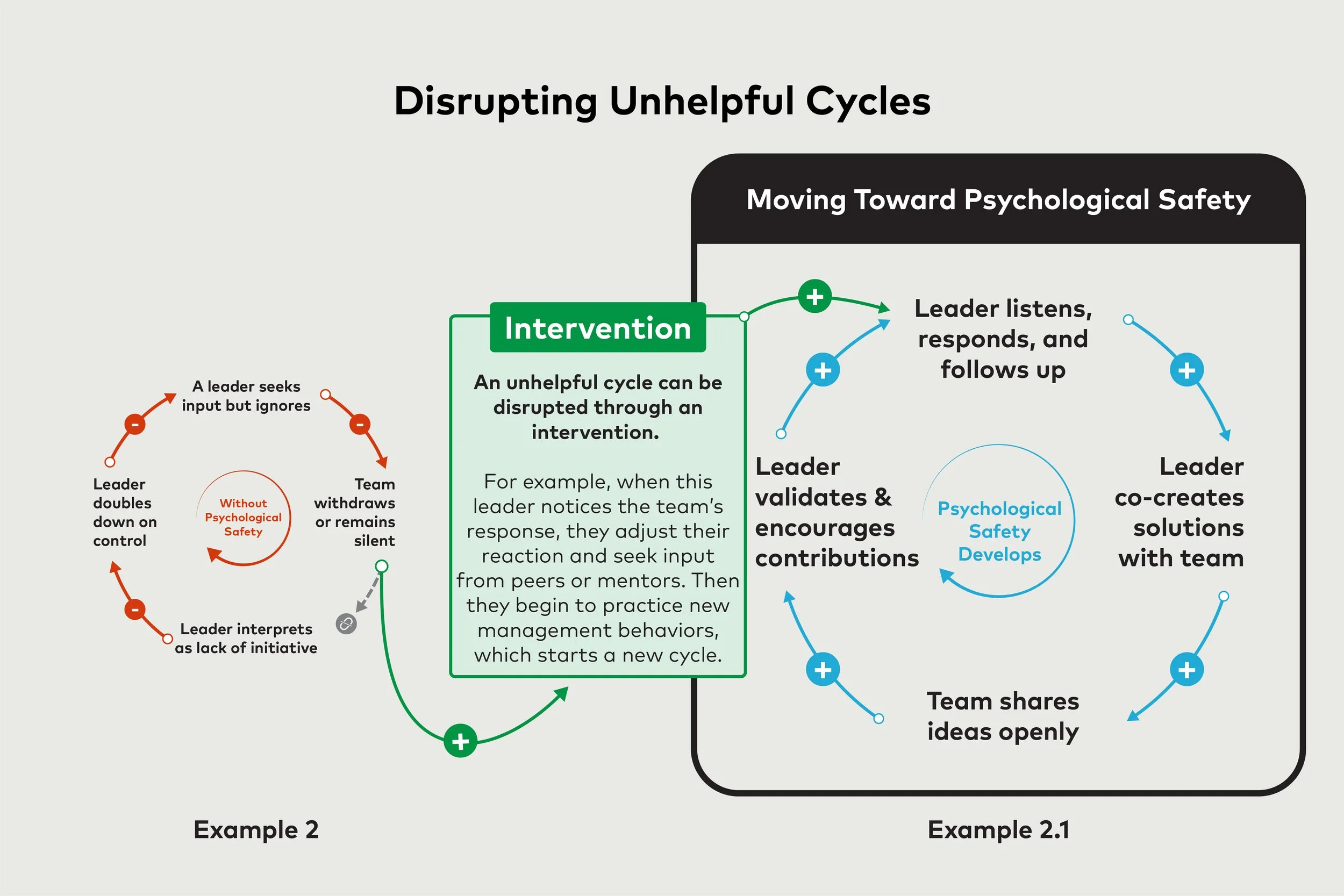
Example #2.1 (Intervention): A leader notices the withdrawal and seeks input from peers or mentors. They recognize that asking for input alone isn’t enough—they must listen, respond, and follow up. They begin practicing curiosity, explaining decisions, and co-creating solutions. This can encourage team members start sharing ideas, which leaders validate and encourage. This begins to form a loop of psychological safety.
These loops demonstrate that psychological safety is not static; it is continuously shaped by interactions. The key is that leaders can intervene at any point to disrupt unhelpful cycles and cultivate supportive ones.
The Risk of Echo Chambers
Even well-intentioned leaders can face the challenge of echo chambers maintained by power structures. Silence or agreement may look like harmony, but it can mask discomfort, dissent, or fear. Recognizing these patterns offers a chance to build curiosity, connection, and inclusion.
Consider how echo chambers can appear at different levels:
Individual level: A café manager asks for input in meetings, but baristas rarely speak up. Interpreting silence as satisfaction overlooks the risks people may feel in speaking up. Noticing and acting on these dynamics strengthens trust and shapes feedback loops that sustain psychological safety.
Team level: Around the cupping table, people may tend to agree with the loudest voice instead of expressing their own opinions. This can lead to decisions—like buying the wrong coffee for your market—that don’t reflect the collective insight of the team.
Organizational level: Managers themselves may not feel safe challenging those above them. Without that psychological safety, critical issues can go unaddressed, creating echo chambers that ripple down the organization. Frontline employees may become further disempowered, hesitant to raise concerns or contribute ideas, and systemic problems persist unnoticed.
By noticing these patterns and actively inviting diverse perspectives at every level, leaders can interrupt echo chambers, ensure more accurate decision-making, and cultivate a culture where everyone’s voice matters.
Building Psychological Safety in Practice
Fostering psychological safety doesn’t require expensive programs—it requires humility, candor, and consistent practice. It’s less a checklist than an ongoing commitment to relational responsibility: noticing how our words, silences, and choices ripple outward to shape what feels possible for others. Curious leaders and teammates seek out multiple perspectives, especially from those most impacted, to maintain an accurate picture of workplace safety. The questions below offer starting points to deepen awareness of how you co-create dynamics in your workplace:
| Theme | For Reflection |
|---|---|
|
1. Safety and Trust When people know their honesty won’t be met with disregard or negativity, they’re more likely to flag mistakes or risks before they grow. |
How do I respond when someone brings me bad news? How might my reactions (verbal, physical, emotional) shape what people choose not to tell me? |
|
2. Transparency Sharing the “why” behind decisions signals respect and builds shared understanding, even if there is disagreement. |
When was the last time I explained the reasoning behind a decision, including uncertainties or learnings? How might withholding my thought process unintentionally reinforce hierarchy? |
|
3. Autonomy and Choice Even small choices—like how a task is approached—can affirm dignity, reduce stress, and spark ownership. |
Where could I offer more choice in how work gets done? In what ways might I be holding too tightly to control? |
|
4. Collaboration When mistakes are treated as collective data rather than personal failings, people are more willing to learn together. |
Do I invite the people most affected by a change to help shape it? What might be preventing genuine collaboration? |
|
5. Empowerment Recognize strengths and celebrate contributions. Even small acknowledgements validate effort and reinforce skills. |
Whose contributions am I quick to notice? Whose might be going unseen? How might biases—conscious or unconscious—shape who I affirm? |
|
6. Cultural and Historical Awareness The coffee industry rests on an intricate web of global labor, yet many voices are often sidelined. Seeking out those perspectives creates more equitable decision-making. |
Whose voices are missing in conversations I’m part of? How can I make room for them? In what ways might I benefit from inequities I want to change? |
Closing
Psychological safety is foundational to equity, well-being, and the future of specialty coffee. As our industry continues to professionalize, we have a choice: pass down workplaces where care is treated as a perk for some, or build an industry where mental and emotional well-being is shared by all. If our commitments to quality, sustainability, and equity are to mean more than words, they must extend to how we treat one another. By practicing psychological safety as a daily act of relational responsibility, we not only create healthier workplaces today but also leave a different legacy for the generations who will carry specialty coffee forward around the world.
References
[1] Amy Edmondson, “Psychological Safety and Learning Behavior in Work Teams,” Administrative Science Quarterly, 44, no. 2 (1999), pp. 350–383, https://doi.org/10.2307/2666999.
[2] M. Lance Frazier et al. “Psychological Safety: A Meta-Analytic Review and Extension,” Personnel Psychology, 70, no. 1 (2017), 113–165, https://doi.org/10.1111/peps.12183.
[3] William A. Kahn, “Psychological conditions of personal engagement and disengagement at work,” Academy of Management Journal, 33, no. 4 (1990), pp.692- 724, https://doi.org/10.2307/256287.
[4] Sheila McNamee and Kenneth J Gergen, Relational responsibility: resources for sustainable dialogue, Sage (1999), https://doi.org/10.4135/9781452243733.
[5] Michelle Bonterre, “Why Psychological Safety Is the Hidden Engine Behind Innovation,” Harvard Business Impact, July 29, 2025, https://www.harvardbusiness.org/insight/why-psychological-safety-is-the-hidden-engine-behind-innovation-and-transformation/.
[6] Claudia Grauf-Grounds, et al. (eds), A Practice Beyond Cultural Humility, Routledge eBooks (2020), https://doi.org/10.4324/9780429340901.
This article by DAPHNE ALLISON, AMFT is part of a wider series sharing insights and practical guidance for roast and retail businesses. You can read the other features in the series here.