The Roaster's Dilemma: How to Thrive in an Age of Volatility
IARA NORONHA, Algrano's Content Team Lead, shares practical insights on how to manage business risks as a roaster. This article is based on a lecture given by Algrano CEO, RAPHAEL STUDER, at the Coffee Science and Education Summit at the Coffee Excellence Center, Zürich University of Applied Sciences. This feature is part of a new series on SCA News, where industry leaders share practical guidance designed to keep coffee professionals informed and ahead in a quickly evolving industry.
Over the past five years, coffee roasters have experienced serious challenges when sourcing green coffee. Coffee prices have fluctuated dramatically; logistics have been frequently disrupted by container shortages and other events, and tariffs have instilled fear and uncertainty.
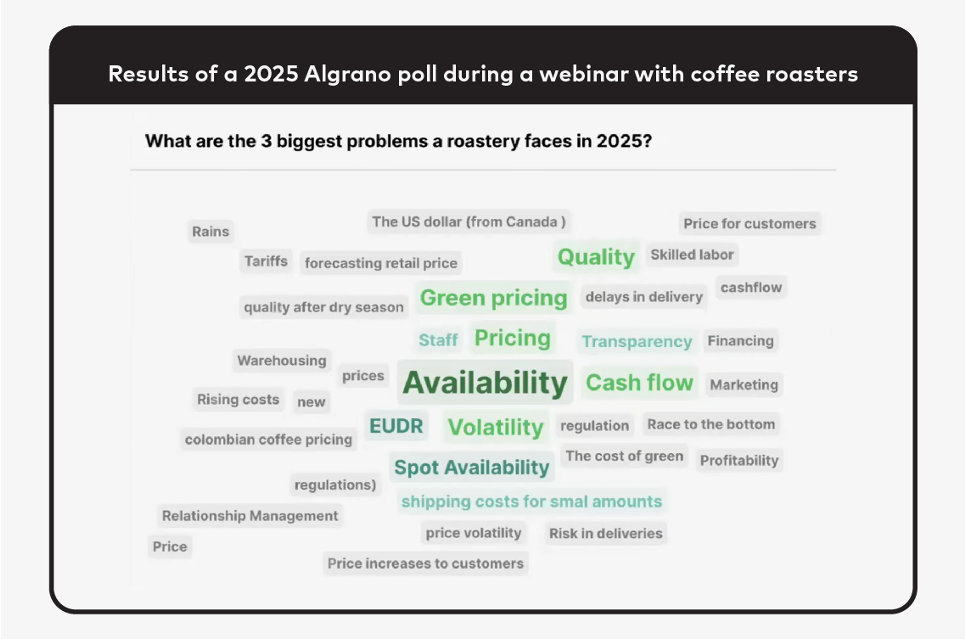
In this context, volatility has become the greatest threat to a roaster’s business stability. This problem is reflected by roasters themselves. In a recent webinar for roasters at Algrano, a poll asking about their biggest challenges for 2025 showed the top concerns were "availability," "pricing," "costs," and "cash flow." These are all symptoms of a volatile supply chain.
Make it stand out
As Donald Sull in Harvard Business Review notes, good companies can fail, not because they make bad decisions, but because they get stuck in the routines that brought them success—even as the conditions shift. Many roasters may now be observing that their once-successful green sourcing strategies feel unsuited to the current moment. For specialty coffee roasters, transactional sourcing (i.e., simply buying from a list of available coffees) is now more complicated and risky than before. So, what could more resilient sourcing strategies look like? This article explores several approaches roasters might consider as starting points for greater stability.
Understanding the Volatility Problem
A core issue facing roasters today is not just the price of coffee, but the unpredictability of that price. While a high price is certainly a challenge for managing margins, it is theoretically manageable, as long as it remains consistent. It is the unpredictable swings—what the industry calls "C-market volatility”—that creates an impossible situation for business planning.
Algrano’s CFO and Head of Data, Florian Schaffner, explains that a roaster can't accurately budget, price their products, or offer stable long-term contracts when their primary cost factor is a moving target. To fully grasp the "C-market," it's crucial to understand it not as a simple price, but as a system of futures contracts traded on the Intercontinental Exchange (ICE). The price you see quoted as "the C-market" is typically the price of the Arabica contract with the nearest expiration date.
When you plot all the different contract prices, you get what is known as a “forward curve.” This curve tells a story about where the market expects prices to go. Historically, the market has often been in contango—a situation where prices for future dates are higher than today's price—but the curve can shift continuously, making timing a purchase a difficult and risky gamble.
This financial instability is compounded by availability volatility. In the past, roasters could generally rely on consistent shipping schedules and predictable delivery times. Today, they face a world of container shortages, port delays, and unexpected defaults on contracts. Sea-Intelligence reported just how severe this is: for all of 2024, nearly half of all container ships arrived late. When a coffee doesn't arrive as planned, roasters are often forced to source coffee at short notice from outside their usual partnerships, making it hard to budget or deliver what their customers want.
The recent U.S. tariffs on imported coffee serve as a stark reminder of this problem. These kinds of disruptions, whether from a government policy or a logistical snafu, amplify the business risks any roaster faces. It’s the duty of every business owner or manager to manage and minimize these business risks. To be successful in managing business risks, a shift in routines is often needed.
The Four Business Risks You Can’t Afford to Ignore
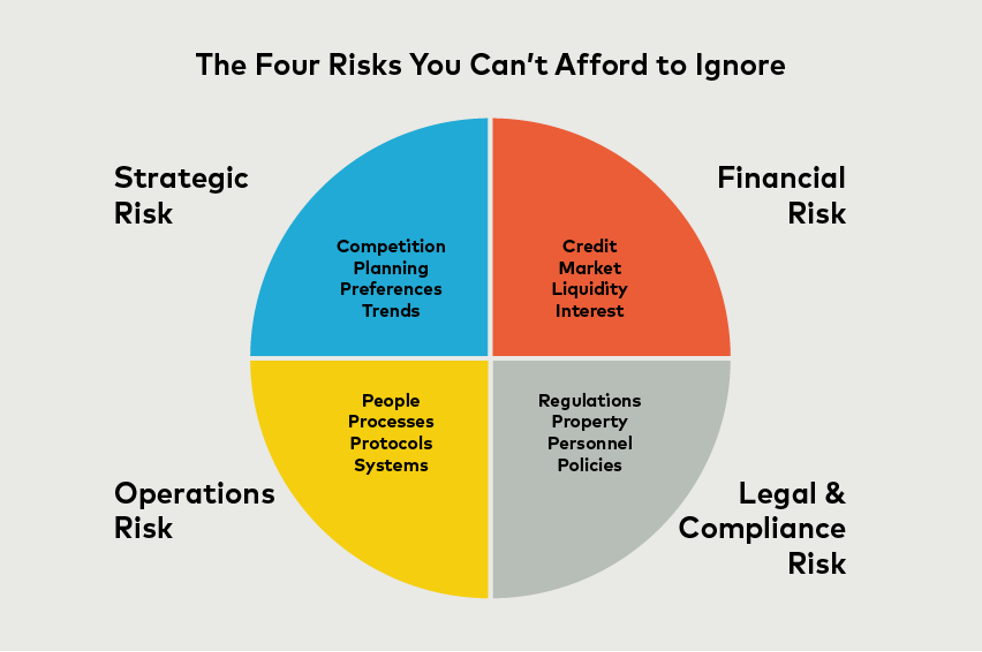
1. Financial Risk: The Perils of Unpredictability
As a roastery scales, the cost of green coffee is one of the most critical line items. When this cost is unpredictable, financial health is precarious. The solution is to move to a business model that allows for long-term price predictability, giving you and your business partners the ability to plan for the future.
Here are two tips for managing financial risk:
Consider building more direct relationships with producers: Volatile coffee prices create a budgeting nightmare. How do you set your prices when you don't know what your costs will be next week, let alone next quarter? A roaster can commit to producers before the harvest by liaising directly—perhaps getting into contact through platforms or trusted intermediaries. By entering into long-term contracts and pre-contracts with producers, both parties gain financial predictability. The producer is no longer a “price taker” but an entrepreneur with a stable income, and the roaster can accurately budget and plan for the future without worrying about market swings.
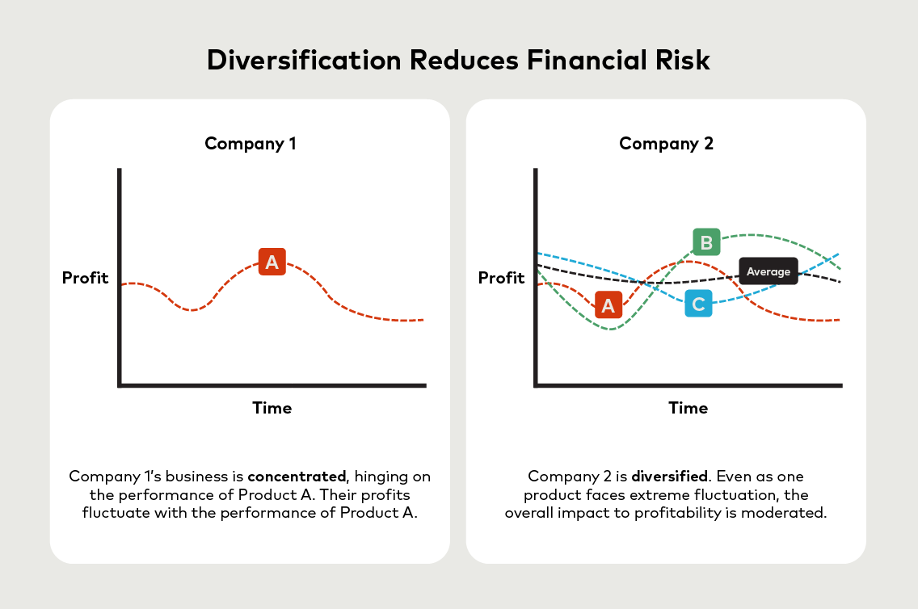
Diversify: You may want to build a portfolio of producer partnerships in different regions. This strategically hedges your business against localized risks like a bad harvest, weather event, or logistical jam in one specific country. If one partner faces a challenge, your relationships in other origins provide a stable foundation.
2. Operational Risk: Gaining Visibility and Control
A roastery's efficiency hinges on managing production and inventory. In the current climate, this is nearly impossible. The journey of a coffee from "at origin" to "afloat" to "at destination" is, in many instances, a black box. This lack of visibility can lead to sudden stockouts—risking reduced sales or even lost customers.
The key to mitigating this risk is establishing a two-way information flow, which is a natural result of a long partnership. When you are in constant communication with your producing partner and their export team, visibility isn't a feature you pay extra for; it's simply part of the conversation.
A Supply Chain Visibility Checklist
Instead of just a single delivery date, roasters can gain more clarity by investigating and requesting the following information:
Forecasted Availability: When is the coffee ready to ship?
Port & Container Status: Is the coffee at the port? Is a container available?
Afloat Status: What is the vessel name and tracking number?
At Destination: What is the estimated arrival date at the destination port and warehouse?
Warehouse Release: When is the coffee available to be picked up from the warehouse?
Having this information provides an operational dashboard that transforms a chaotic supply chain into a manageable process. Even if the schedule shifts, this overview allows you to identify delays quickly and plan accordingly with your partner, like informing customers in advance or adjusting your offer list. This is the difference between being a reactive business putting out fires and a proactive business that can plan and scale effectively.
3. Strategic Risk: Building a Brand That Differentiates
In a market where many roasters source from the same limited importer offer lists, it’s increasingly difficult to build a unique brand. True differentiation comes from a deeply embedded, authentic, and consistent sourcing story—a product no competitor can easily replicate. Strategic risk emerges when internal or external factors challenge a company’s ability to meet its objectives, such as building a unique brand or carving out a market share.
One strategic approach, as demonstrated by companies like the Parisian roastery Coutume, is to organize your menu into branded categories. Coutume divides its coffees into three main categories: "Apprécier" (Appreciate), "Explorer" (Explore), and "Déguster" (Savour). All coffees within a category have the same price, which simplifies the consumer's purchasing decision and removes price pressure. More importantly, this structure gives the roastery enormous flexibility: a green buyer can source different coffees throughout the year that fit a particular category's profile. Customers become accustomed to seasonal rotation within a consistent range of flavors and attributes they trust, rather than expecting the same specific coffee year-round.
As an added benefit, roasteries can use menu categories to target marketing and education to interested segments of their audience. Customers drawn to categories like "Explore" or "Adventure" may be interested in innovative processing techniques, while those attracted to "Sustain" or "Nurture" may be most receptive to learning about farmers' sustainability initiatives.
By creating branded coffee categories, roasteries help customers navigate their menu based on preferences and values rather than the availability of a single origin. This builds brand loyalty while showcasing both the roastery's expertise as curators—matching consumers to coffees that suit them and highlighting the expertise and strengths of different producers—all while giving the business the flexibility to adapt to supply chain volatility.
4. Legal & Compliance Risk: The Coming Era of Transparency
For years, certifications were a proxy for traceability. Now, new regulations like the European Union Deforestation Regulation (EUDR) are fundamentally changing the game. EUDR is a legal mandate for transparency, requiring businesses to prove their products are not linked to deforestation, right down to the GPS coordinates (or more detailed polygons) of a farm.
The key to managing compliance risk in this landscape is to move from demanding data to sharing it—acknowledging that compliance is challenging for all parties, and it’s best achieved when pursued in partnership. When you build partnerships on reciprocal feedback loops, rather than one-way information requests, you create mutual transparency that protects both businesses from regulatory shifts and empowers producers to invest in strategies that meet your market's needs. In practice, this might look like a two-way sourcing audit where both parties benefit from sharing data and understanding how to meet compliance requirements.
Supplier Side Data:
Producer Information: Full name and contact details of the producer.
Farm Details: Geographic location, including GPS coordinates. This is now a legal requirement for EUDR compliance.
Farmgate Price: A record of the exact price paid to the producer. This ensures ethical sourcing claims are backed by data.
Compliance Documentation: Proof that the farm is not associated with deforestation and adheres to local land-use laws.
Process Transparency: A clear understanding of the coffee's journey from the farm, through processing, and to export.
Buyer Side Data:
Retail prices: Prices paid by the end consumer for whole bean coffee or cups of coffee
Consumption trends: Preference maps or indicators of which varieties, processes, or flavor profiles perform best in different regions where you operate.
Retail costs: Sharing costs like shipping or labor as a percent of the total price can help producers understand pricing differentials.
Marketing strategies: How is the coffee being presented?
This audit is not just about avoiding legal trouble; it’s about building a foundation of trust between producers and roasters and their end customers, who are increasingly demanding to know the full story behind their cup of coffee.
The Shared Challenges of Producers
Producers, particularly smallholder farmers, face their own set of unpredictable challenges such as lack of market visibility, limited customer bases, and intense financial unpredictability. Climate change is a major one. As one Ugandan producer noted, "The issue with climate change is that the weather isn't predictable." This makes it impossible for them to plan and can threaten their entire harvest. Financing is scarce, as lenders grow cautious. As a result, many producers are forced to sell to whoever gives them the best price today, rather than building long-term relationships. They are stuck in the same reactive cycle as roasters.
The good news is that the same volatility threatening roasters creates an opportunity. By sharing your data with partners, producers can better manage through the same four risks, resulting in a more resilient and informed value chain.
A Call to Action: Your Three Strategic Steps
The coffee industry is at a crossroads. Reacting to market prices and relying on intermediaries is no longer viable. The future belongs to roasters who confront volatility by building resilient, transparent, and collaborative supply chains.
To begin, take three actions: First, understand the drivers of volatility and their impact on your company. Second, evaluate your exposure to the four biggest risks. Finally, lean into strategic partnerships to improve supply chain visibility.
This shift isn't just a defensive move against volatility; it is the new frontier of competitive advantage in specialty coffee. The roasters who embrace genuine partnerships won't just survive the dilemma; they can help establish new, more resilient business practices that shape the sector.
This feature is part of a new series on SCA News, where industry leaders share practical guidance designed to keep coffee professionals informed and ahead in a quickly evolving industry.