From Stigma to Specialty: Developing the Canephora Flavor Wheel | 25, Issue 25
Neuroscientist DR. FABIANA CARVALHO explores the specialty coffee sector's perceptions of canephora and how the development of the new Canephora Flavor Wheel could help cuppers better describe and value the species' sensory potential.
Photo credits: Dr. Enrique Alves, Embrapa

Introduction by MARIO FERNÁNDEZ-ALDUENDA, SCA Technical VP
One of the main motivations for the SCA to develop the CVA was the concept of diversity. People usually interpret that idea as a need to cater to diverse, global, specialty coffee markets. The truth is we were also motivated by the other side of the diversity coin—an increasingly diverse offer of coffee species and varieties, processing methods, and coffee flavors. The growing diversity in the supply matches the diversity we find across the specialty markets. It feels liberating to now see diversity and innovation unbound.
In this new landscape, of course there is room for robusta (also known as canephora, and referred to as such in the following piece) coffee to become specialty—why not? All what a canephora needs to become specialty coffee is to show distinctive attributes, and because of these attributes, to have significant extra value in the marketplace. This is obvious in the light of the current paradigm. What is not obvious is how to assess and measure attributes that may be specific to a coffee species, when our industry’s tools have been historically designed for washed arabicas. The SCA/WCR/UC Davis Coffee Taster’s Flavor Wheel is an example of those tools, working very well to assess coffee’s attributes but developed in a time with lower diversity in the specialty market. The work done by Dr. Fabiana Carvalho and her team to bridge such gape and develop a flavor wheel for canephoras was timely, necessary, and yielding high-quality results.
After you read her article, you might wonder what will happen in the future – will we keep separate wheels for canephoras and arabicas or somehow merge them? At SCA we believe that the approach to assess diverse coffees is not to have a diversity of systems, but a system flexible enough to evaluate the different types of coffee. Thus, in the mid-term future, we would like to revise the Flavor Wheel, to include the flavors unique to canephoras revealed by Dr. Carvalho’s team, and other new flavors appearing in the coffee palette, so that we only need to keep using one wheel. Stay tuned.

Amazon robusta growing in Rondonia State, Brazil.
The species Coffea arabica (arabica) and Coffea canephora (often known as robusta, but here referred to as canephora)[1] are different in numerous and interesting ways.
These distinctions span their genetics, ideal soil and climate conditions, and the way their fruits develop and ripen. These differences greatly impact their flavor precursors and roasting chemistry, resulting in different sensory attributes in the final cup.

Amazon robusta growing in Rondonia State, Brazil.
Historically, many consumers and coffee professionals have assumed that canephora is inherently low quality—comparing it negatively to arabica rather than celebrating the species for its unique attributes. This stigma led to its being excluded from high-value systems like the specialty coffee movement and alternative value chain systems, such as direct or fair trade. The perception of canephora as "bad coffee" has weakened the motivation for quality improvement, reinforcing unsuitable post-harvest processing practices, and in turn resulting in a reputation for defective beans and negative flavor attributes.
Amazon robusta growing in Rondonia State, Brazil. Amazon robusta processed using different methods in Rondonia State, Brazil. Negative perceptions of canephora have even influenced the way we describe and label it. In many grading systems and in trading communication, the term "specialty" specifically refers to arabica, while the term "fine" is used for canephora. While some systems (such as the Specialty Coffee Association's Coffee Value Assessment) are gradually moving away from a species binary, these evaluation protocols have ingrained divisive terminology within the industry. Although the media and coffee sector have often celebrated canephora's genetic attributes as important in the face of climate change,[2] negative stereotypes about canephora cup quality often prevent it from being widely embraced as a realistic alternative to arabica by specialty coffee growers and buyers.
Only recently has improving canephora cup quality become a target of several coffee improvement programs, which are opening doors to diverse sensory profiles and acceptance in the specialty coffee market. Increasingly, producers are applying innovative processing methods to canephora coffees at origin, and canephora is making an appearance on specialty roasteries' offer lists and in coffee competitions. To fully utilize the species' numerous positive attributes, we must look beyond its mere "robustness" and learn to accurately describe its exciting sensory potential.
As a group of researchers in the coffee sector, we believe that building an accurate and standardized sensory wheel for describing canephora flavor and aroma is essential to this continued growth. With this goal in mind, we launched a study[3] in 2022 with two primary aims: (1) to create a descriptive tool to identify, understand, and map the sensory characteristics of canephora coffees that are most important or valued in different markets, and (2) to explore whether trained cuppers in different markets would describe and score canephora coffee in different ways.
Why a Descriptive Tool for Canephora?
The Coffee Taster's Flavor Wheel (created in 1995 and revised by the Specialty Coffee Association and World Coffee Research in 2016) has become an important tool for teaching and learning how to describe coffee's sensory attributes. The 2016 flavor wheel was created from attributes identified in 105 samples: 33 arabica samples from Colombia, 45 commercial coffees (including arabica, "robusta," and blends), and 27 specialty arabica samples from various regions.[4] However, high-quality canephora samples were not included in the research, leaving many positive traits of canephora coffees unrepresented.
Arabica and canephora exhibit clearly distinct sensory profiles, which graders often describe as similar to the differences between white and red wine. Arabica is generally perceived as "more delicate," while canephora is regarded as having a "deeper" flavor profile. Another important difference is the observation by coffee professionals of positive "savory" or "umami" notes in canephora (such as shōyu or tomato), which are not represented in the arabica flavor wheel.
We decided to create a dedicated flavor wheel to identify, understand, and map the sensory characteristics of canephora coffees that are most important or valued in different markets. To make sure that we captured the most important sensory descriptors of graders from different markets, we worked with a total of 49 cuppers from Brazil and Europe[5] to determine the most prevalent descriptors they found in canephora.
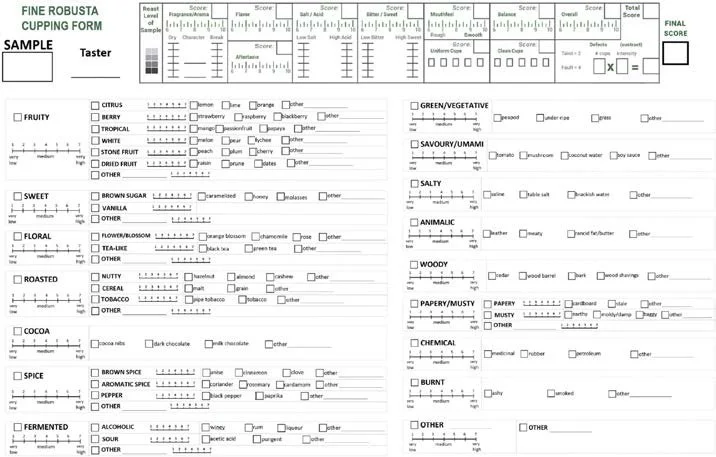
Figure 1. The full scoring and descriptive form that we used in all cupping sessions. Upper panel: The Fine Robusta Cupping Form from the CQI/UCDA Fine Robusta Classification System. Lower panel: Final Rate-All-That-Apply (RATA) list.
Study Methodology and Sample Selection
We sourced a total of 67 canephora samples from 13 countries: Brazil, the Democratic Republic of Congo, Costa Rica, Cuba, Ecuador, Ghana, Guatemala, India, Indonesia, Mexico, Peru, Uganda, and Vietnam. To ensure these samples represented the wide range of possible flavor attributes, we selected coffees varying in graded quality level (low to high), post-harvest processing method (dry and wet), and producing sites across four continents (South and Central America, Africa, and Asia).
The study was conducted in two phases. In the first stage, exporting graders in Brazil and importing graders in Switzerland evaluated the same 24 samples. In this first round of cupping, known as the "development" stage, we aimed to gather as many descriptors as possible from the diverse set of coffees. The second cupping stage, referred to as the "validation" stage, was carried out in Brazil with exporting graders.
In the validation stage, cuppers were asked to evaluate whether the descriptors identified in the first stage were broad enough to characterize the sensory characteristics of a second, diverse set of 33 coffee samples, all previously graded as "fine" or "specialty." In the second stage we included coffees that had been roasted between one day and six months prior to the cupping, making sure that we captured canephora's sensory profile as it goes through phases of de-gasing and degradation.
Cupping Protocol and Sensory Evaluation
In both stages, we asked cuppers to grade the coffees according to the Coffee Quality Institute/Uganda Coffee Development Authority (CQI/UCDA) fine robusta cupping protocol and describe them using a Rate-All-That-Apply (RATA) list[6] (see figure 1). Descriptors for the RATA list were drawn from published research on coffee descriptive analysis, along with a previous database of cupping scores and descriptors from 2,300 Brazilian canephora coffees evaluated at the Federal Institute of Espírito Santo between 2019 and 2023.
Using the RATA list (see figure 1), cuppers first rated the intensity of broad (Tier One) fragrance and aroma notes, such as "fruity," on a one-to-seven scale. They then rated the intensity of more specific nuances (Tier Two) within those categories (e.g., "citrus fruit"), followed by ratings for specific flavor notes (Tier Three) (e.g., "lemon"). Finally, cuppers were asked to record any other perceived fragrance or aroma descriptors before repeating the entire process for flavor notes.
Cuppers were also asked to score the coffees according to the CQI/UCDA cupping protocol, shown at the top of figure 1. A key difference in this canephora-specific protocol, compared to arabica-oriented protocols, is that acidity and sweetness are not evaluated independently. Instead, they are evaluated relative to saltiness and bitterness, resulting in an acid:salt ratio and a sweet:bitter ratio, respectively.
Figure 2. Mean scores (a combination of frequency and intensity) of the tier one RATA flavor attributes given by exporting graders (Brazil, green bars) and importing graders (Switzerland, red bars). The presence and number of asterisks indicate statistical significance. Note that graders in Brazil had a higher mean score for categories such as “Green/Vegetative” and “Papery/Moldy,” and the graders in Switzerland had a significantly higher mean score for “Fruity.”
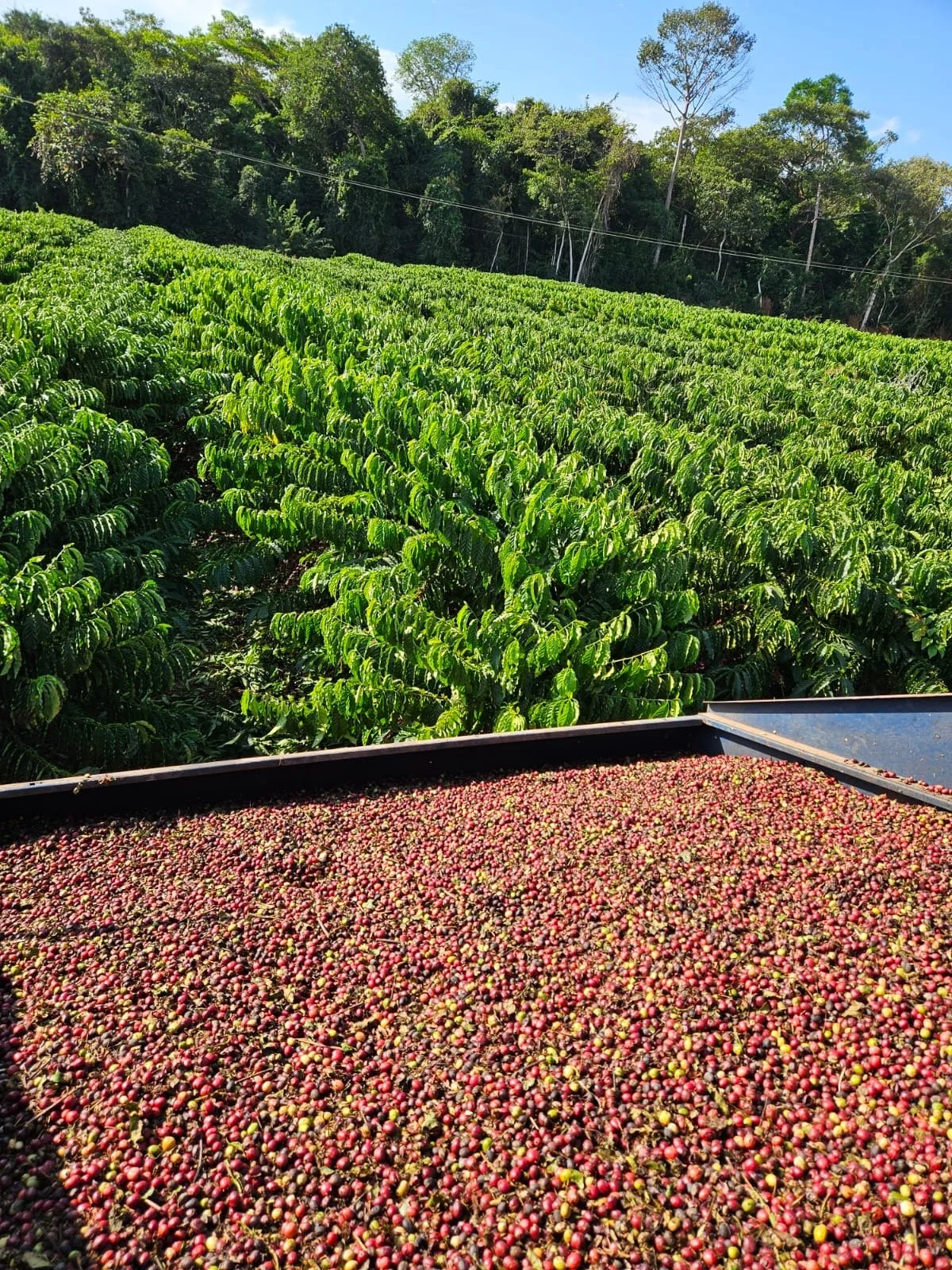
Naturally processed canephora in Rondonia State, Brazil.
How Exporting and Importing Roles Shaped Cuppers' Perceptions
Based on these protocols, we were able to compare how different markets evaluated the same coffees, revealing some significant differences between the two groups of graders. Importing graders rated both low-grade and specialty coffees higher than exporting graders did, with the discrepancy being particularly noticeable for low-grade coffees. In simpler terms, importing graders were more lenient in their evaluations, especially for low-grade coffees, compared to exporting graders.
Despite the recent movement toward standardizing coffee grading systems by the SCA and CQI, most exporters in Brazil classify their coffee using the Brazilian Official Classification for Coffee (COB). This system places a strong emphasis on the absence or presence of sensory defects to determine quality categories, ranging from the highest ("strictly soft") to the lowest ("rioy and Rio"[7]). For example, for a coffee sample to be classified as "soft," or "strictly soft," it must not exhibit astringency; otherwise, it is downgraded to hard, the next category down. Similarly, a sample classified as "hard" must not have "phenolic/medicinal" aroma/flavor notes; otherwise, it falls to the level of "rioy." Because this method focuses primarily on negative attributes, Brazilian graders receive extensive training in detecting and naming defective notes in coffee.
We found this reflected in the results of the RATA assessment (see figure 2). For example, exporting graders rated Tier One categories that we considered defective, such as "paper/moldy," "chemical," and "salty," higher than importing graders did. We noticed that the "fruity" category had the highest mean score among importing graders, whereas the "sweet" category had the highest mean score for exporters. Since professional cuppers learn to evaluate coffee according to their market's needs, we included cuppers from both the importing and exporting sectors to ensure our international lexicon avoided bias toward specific attributes—for instance, over-emphasizing fruity notes found in import markets or disproportionately weighting negative characteristics detected in export markets.
Figure 3. Final list of the 103 descriptive terms with an average mean score ≥ 0.5 generated by the graders from all coffee samples. The descriptors are presented grouped according to their Indices. The higher the Index, the more the descriptor contributes to the overall aroma/flavor characteristics of canephora coffees.
Building a Flavor Wheel for Canephora
The first step after recording all the descriptive terms was to merge similar terms to avoid repeated or redundant words. For example, we merged the descriptors "butterscotch," "toffee," "fudge," and "doce de leite" into "caramel" and the descriptors "phenolic," "iodoform," "paracetamol," and "rioysh/rio/riado" into "medicinal." We then calculated an average mean score for each descriptor by combining its frequency and intensity ratings across all graders. This score provides a single, weighted index of a descriptor's prevalence.
We finalized 103 descriptive terms and organized them into a three-tiered, hierarchical structure based on specificity, resulting in the flavor wheel (which you can access free online).[8] The tiers move from broader categories in the inner circle (e.g., "spices"), to detailed subcategories in the middle circle (e.g., "pepper"), to the most specific descriptors in the outer circle (e.g., "paprika").
The position of the inner-circle categories was determined by their average mean scores, progressing clockwise from lowest to highest starting at 270 degrees. This placement means "roasted" appears first, indicating it has the highest index, followed by "sweet," "fruity," and "cocoa," down to "salty," which had the lowest index. This graphic arrangement provides tasters with immediate information about the most and least common attributes, which is important for descriptive assessment. These findings challenge assumptions that canephora lacks sweetness and fruity notes and is primarily characterized by intense earthy and bitter aromas and flavors.
While there is considerable overlap between the canephora descriptors and the descriptors represented in the Coffee Taster's Flavor Wheel, there are also important differences. Whereas in the Coffee Taster's Flavor Wheel, "Woody" is a subcategory of "Papery/Musty," in canephora we identified more positive woody notes such as oak barrel and cedar. We also noted aromatic spices such as cardamom and rosemary and fermented alcoholic descriptors such as rum and liqueur that are not individually represented in the 2016 wheel. Other notable descriptors such as tomato, fermented soy sauce (shōyu), coconut water, and mushroom were included under the category "umami" which appears to be more prominent in canephora coffees. We also identified a group of descriptors that have animal and dairy associations, such as leather, fishy, and buttery, which we categorized as "animalic."
Just as flavor descriptions for red and white wine emphasize different structural attributes (e.g., tannins for red vs. acidity for white), a specific lexicon is important for accurately describing canephora. Our cupping sessions confirmed a diverse range of flavors and aromas that are not included in other descriptive lexicons. We believe that including and assigning them proportionate prominence in a canephora-specific flavor wheel will help cuppers to describe, calibrate on, and better understand this species.

Amazon robusta processed in Rondonia State, Brazil.
Exciting Prospects: The Role of Specialty Canephora in the Market
We know that many consumers appreciate flavors commonly found in canephora. For example, a survey of US coffee consumers from the National Coffee Association found that in 2023 and 2024 the top three terms that would make consumers "much more" or "somewhat likely" to buy a coffee were "roasted," "sweet," and "chocolate"—the three most prominent categories of the Canephora Flavor Wheel (see figure 4).[9]
Figure 4. The National Coffee Association asked US-based consumers “What effect do each of these flavors/aromas have on your interest in buying their coffee?” The top three terms that impacted consumers’ likelihood of purchase were also the three most prominent categories of the Canephora Flavor Wheel.
Narrowing the gap between the industry standards and consumer interest in the sensory characteristics of canephora coffees is important. The flavor wheel also provides a tool for organizations working in quality improvement (from genetic research to crop practices) to accurately describe coffees and benchmark their improvements over time. This will help us to grow our understanding of quality in C. canephora, which is essential for product improvement and value creation. We propose that the concept "specialty" is appropriate and relevant to all coffees that fulfill the prevailing definition criteria and should not be exclusive to one coffee species only. This is vital for fostering acceptance and recognition of canephora coffees within the specialty coffee market.
It has been reassuring to see the Canephora Flavor Wheel embraced by producers, traders, and roasters as a means to explore and connect with the sensory characteristics that these coffees can offer. I'm grateful to the first canephora coffee that opened my mind to a new sensory world back in 2021, with all its velvetiness of butterscotch, mango, and a hint of aromatic spice—all flavors that are captured in the flavor wheel. Since then, it's been an exciting personal journey in discovering the flavor possibilities of canephora, learning to describe the species according to its unique attributes.
FABIANA CARVALHO, PhD, is a Neuroscientist specializing in specialty coffee, flavor, and multisensory experience. She is a collaborating researcher at the University of Campinas, Brazil, and the founder of the Coffee Sensorium, a research project focused on understanding multisensory flavor perception, particularly the influence of extrinsic factors on the expectation and perception of flavor in specialty coffee. The designed version of the Canephora Flavour Wheel is available for download free of charge on The Coffee Sensorium website.
References
[1] Research over the past four decades has identified up to eight distinct diversity groups within the species Coffea canephora. These groups fall into the Congolese and Guinean genetic categories, which are commonly referred to as "robusta" and "kwilu" (a word that evolved into "conilon"). Researchers are discovering additional subgroups and hybrids. This means that, while all robustas are canephoras, not all canephoras are robustas.
[2] Taís Rizzo Moreira, Samuel Ferreira da Silva, Nathan Bruno da Silva, Gleissy Mary Amaral Dino Alves dos Santos, and Alexandre Rosa dos Santos, "Global Warming and the Effects of Climate Change on Coffee Production," in Quality Determinants in Coffee Production. Food Engineering Series, edited by L. L. Pereira and T. R. Moreira, Springer Nature, 2021.
[3] You can read our academic journal article on the research at Fabiana M. Carvalho, Enrique A. Alves, Mateus M. Artêncio, et al., "Development of a Flavour Wheel for Coffea Canephora Using Rate-All-That-Apply" Scientific Reports 15 (2025), https://doi.org/10.1038/s41598-025-99921-w.
[4] Edgar Chambers IV, Karolina Sanchez, Uyen X. T. Phan, Rhonda Miller, Gail V. Civille, and Brizio Di Donfrancesco, "Development of a 'Living' Lexicon for Descriptive Sensory Analysis of Brewed Coffee," Journal of Sensory Studies 31, no. 6 (2016): 465, https://doi.org/10.1111/joss.12237.
[5] Forty graders were certified Q graders and/or R graders. Only graders (certified or not) who had been grading and tasting both C. arabica and C. canephora for at least two years were included in the study. The graders were recruited according to the type of coffee business they are involved with, namely, exporting (31 graders from Brazil) or importing (18 graders from various nationalities working in coffee importing in European Union countries).
[6] RATA is a sensory evaluation method where participants first select all applicable attributes from a list and then rate the intensity of each selected attribute. It combines aspects of both Check-All-That-Apply (CATA) and traditional rating scales to provide a more detailed sensory description.
[7] You can learn more about the Rio sensory defect at Jean-Claude Spadone, Gary Takeoka, and Rémy Liardon, "Analytical Investigation of Rio Off-Flavor in Green Coffee," J. Agric. Food Chem. 38 (1990), accessed via University of Oregon.
[8] Figure 2 from Carvalho, Alves, and Artêncio, et al., https://www.nature.com/articles/s41598-025-99921-w/figures/2.
[9] National Coffee Association and Specialty Coffee Association, National Coffee Data Trends: Specialty Coffee Breakout Report 2025, https://sca.coffee/sca-news/2025-national-coffee-data-trends-report-available.
We hope you are as excited as we are about the release of 25, Issue 25. This issue of 25 is made possible with the contributions of specialty coffee businesses who support the activities of the Specialty Coffee Association through its underwriting and sponsorship programs.Learn more about our underwriters here.