Beyond Arabica and Robusta: Research to Redefine Liberica and Excelsa Coffee | 25, Issue 25
DR. AARON DAVIS, Senior Research Leader of Plant Resources and Head of Coffee Research at the Royal Botanic Gardens, Kew, shares the history of Liberica coffee, recent genomic research that has redefined it as three distinct species, and how Liberica and Excelsa’s climate resilience and unique flavor profiles offer new opportunities for the specialty coffee sector.
Editor’s Note: In this feature we defer to the author’s preference of capitalizing the first letter of vernacular names of coffee species.

Introduction by PETER GIULIANO, SCA Senior Advisor, Scientific Communication and Engagement Strategy
For many people, “coffee science” is about treating our beverages like a chemistry experiment: understanding extraction dynamics, flavor compounds, acids and oils and sugars. But coffee science can be much more broadly understood—and can include a variety of disciplines, such as botany.
This became crystal clear to me the first time I met Aaron Davis. The context was a SCAA (Specialty Coffee Association of America) conference in 2013 where we were talking about some pretty scary subjects. Coffee leaf rust was spreading fast and had become a serious problem for Latin American coffee farmers. 2012 had been an unusually warm year, underscoring the reality of climate change as a reality for the coffee world. To address these issues, the industry had come together to establish World Coffee Research, an organization dedicated to understanding and improving coffee genetics. But, what did I know about coffee as a plant? I knew it evolved in Ethiopia, and that we farmed several varieties, but that was about the extent of what I and most coffee professionals knew.
That’s where Dr. Davis came in. He presented a talk entitled “Coffea arabica: From Origin to Extinction” that electrified me. He used botany as a lens to understand arabica's indigenous environment in East Africa, and how a changing climate meant wild coffee was under threat. And he also outlined a framework where we could engage with other species in coffea genus to improve coffee’s quality, resilience, and sustainability. This one talk made me understand the amazing natural resource that genetic diversity in the wild represents- that the seeds of coffee’s future might be growing right now in other places, and within other species of coffee.
Ever since, Aaron has become a passionate advocate for engaging with non-arabica species, using his botanical perspective to help us see the coffee world in a broader way. In this piece, he introduces us to Coffea liberica, a potentially important and exciting species. He also shares chemical insights into liberica and other species, and how those might lead to new and interesting flavors. It’s an exciting way that the science of botany- and a scientist like Aaron—is helping pave the way for a better coffee future.
- PETER GIULIANO, SCA Senior Advisor, Scientific Communication and Engagement Strategy
Excelsa coffee is re-emerging as a viable coffee crop species in Africa and Asia for several reasons, including its use for climate change adaptation and as a response to increasing consumer demand for alternative coffees.[1]
The Rise, Fall, and Quiet Survival of Liberica and Excelsa
Liberica is nothing new, of course, and has a long history of cultivation and use. The first European to document Liberica was the Swedish botanist Adam Afzelius, who traveled to Sierra Leone in 1792. In the Appendix to the Report of the Sierra-Leone Company, published in 1794, Afzelius stated: “Coffee trees of two distinct species, both nondescript; but whether of any use is not yet ascertained.” As Afzelius was reporting on the cultivation and use of various staples, vegetables and fruits, it can be assumed that coffee was among the plants being farmed in Sierra Leone at that time. These two coffee trees were later identified as Liberica and the Highland Coffee of Sierra Leone. It was not until almost 100 years later, in 1874, that Liberica was legitimately named as a species: Coffea liberica. The Highland Coffee of Sierra Leone was given the scientific name Coffea stenophylla in 1834.
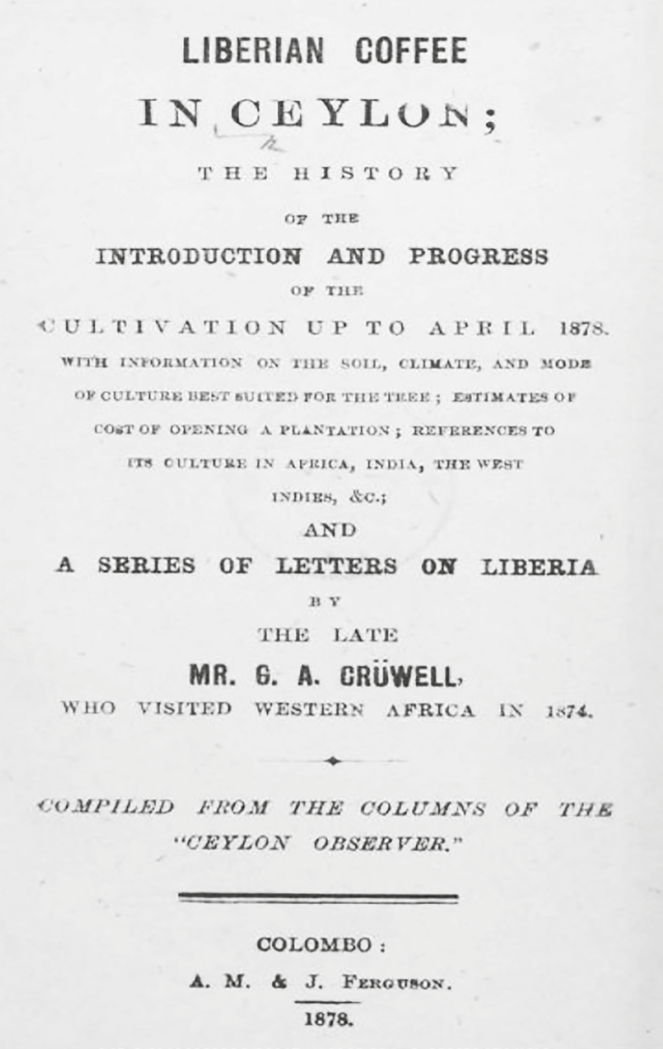
An 1878 publication published in Colombo, Ceylon (part of today’s Sri Lanka), detailing a history of“ Liberican Coffee,” including notes on its cultivation and culture in West Africa, India, and the West Indies.
Small-scale trade of Liberica (or Liberian) coffee, from Liberia to the US, started in 1865. By 1887, Liberica was the dominant species exported between Africa and America. Meanwhile in Asia, in response to the emergence and rapid spread of coffee leaf rust in Sri Lanka (then Ceylon), which caused the annihilation of Arabica plantations, Liberica was introduced shortly after 1869 to restore coffee production on the island. As the coffee leaf rust epidemic swiftly spread across Asia, Liberica followed in its wake to replace Arabica. During this period, Liberica was also sent to many other countries across the tropical belt, notably via the Royal Botanic Gardens, Kew, in England, to enable coffee farming in the lowlands of hot, high-rainfall regions, where Arabica could not be grown.
By the end of the nineteenth century, Arabica and Liberica were the two main species of global coffee trade, with Robusta only fulfilling a minor role as a commodity crop species. Despite its early success, as the twentieth century progressed Liberica rapidly fell out of favor with growers, exporters, and consumers, and Robusta production steadily and consistently increased, to eventually become the key global crop species it is today. Other coffee species put in a brief and modest appearance during the late nineteenth and early twentieth centuries, including Excelsa (C. dewevrei), Stenophylla (C. stenophylla), Ibo or Zanzibar coffee (C. zanguebariae), and racemosa (C. racemosa), but these were made redundant by the steadfast popularity of Arabica and agronomic superiority of Robusta.
Of the other coffee species mentioned above, Excelsa achieved the most commercial interest, but its adoption was short-lived and tragic. Excelsa was unknown to Europeans until the very end of the nineteenth century, being first recorded in the Democratic Republic of Congo in 1896, and then in the Central African Republic in 1901. The French identified enormous potential for Excelsa farming in the Central African Republic. From the early 1930s onwards, plantations totaling 10,000–20,000 hectares were rapidly established. Despite great promise, these plantations were devastated from the early 1940s onwards by coffee wilt disease, putting an end to further expansion in that country.[2] The upscaling in the Central African Republic lacked careful regulation of planting material and effective control of coffee wilt disease. Elsewhere, Excelsa was widely distributed across the tropical coffee belt during the 20th century, where it was cultivated on a small scale, grown as a curiosity, or used as a means of control for coffee berry borer.
Although Excelsa never became a global crop species, and global production of Liberica collapsed by the early twentieth century, both survived as a coffee crop species for in-country consumption, notably in Malaysia and Liberia for Liberica, and the Philippines for Liberica and Excelsa.
Adaptation for a Changing Climate
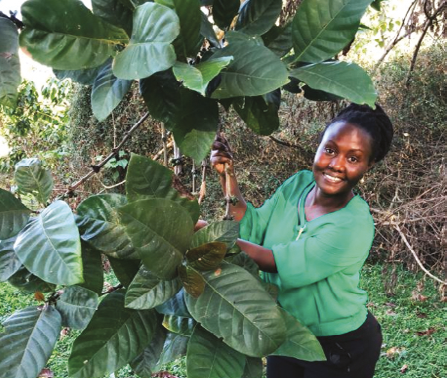
Dr. Catherine Kiwuka, a coffee specialist and in-situ conservationist at National Agricultural Research Organization (NARO) in Uganda with an Excelsa coffee plant. Kiwuka was a co-author of The Wild Coffee Resources of Uganda and other recent scientific publications. Photo copyright: Aaron Davis.
History is important. The coffee leaf rust crisis of the late 1800s teaches us a key lesson: disruption drives change. Coffee leaf rust was the causal agent of a dramatic shift in global production, from a sector entirely dominated by Arabica, to one shared with Liberica, at least for three decades, and sparked the establishment and rapid spread of Robusta coffee. The result is the Arabica–Robusta duopoly we have today. We are now witnessing another major disruptive event in the coffee supply chain, that of climate change. Across the world's coffee production belt, farmers are reporting climate-related issues in coffee farming. These reports range from reductions and inconsistency in quality, yield and plant health, crop failures, and in extreme circumstances the death of coffee trees.
These outcomes are the result of myriad changes in climate variables, including excessively elevated temperatures, too little or too much rain, and changes in seasonality. In most cases, it is the interplay between rainfall and temperature, acting antagonistically, that leads to production issues. Other common themes among farmer feedback are shifts in flowering and fruiting seasons, less seasonal predictability, extreme weather events, and the increasing frequency of extreme weather.
Despite the common and yet misplaced notion that Robusta is more climate resilient than Arabica, both species are being influenced by climate change. As coffee plants become increasingly stressed by unsuitable climatic shifts, they may also become increasingly prone to pests and diseases.
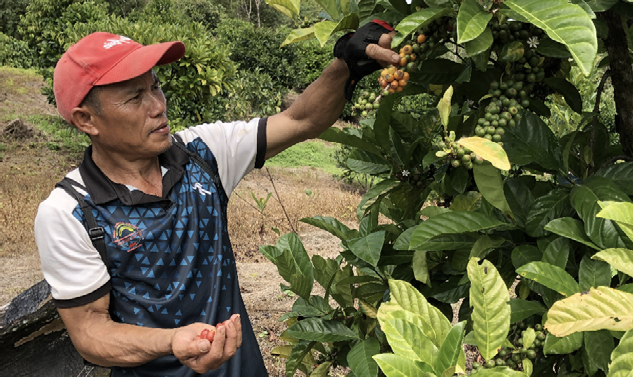
Ben Lie with Liberica coffee growing on his farm at 500 meters above sea level on Sarawak, Malaysian Borneo. Consumer demand is driving an increase in Liberica production in the region. Photo copyright: Aaron Davis.
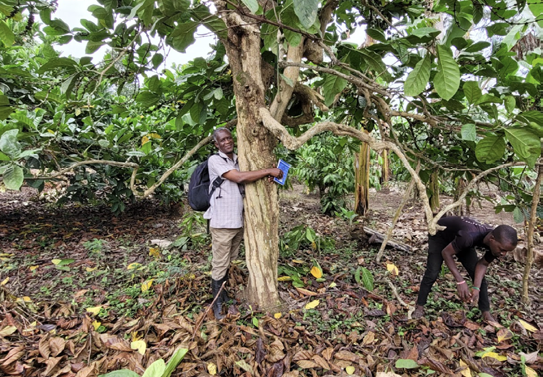
Professor James Kalema from Makarere University, Kampala, with an Excelsa “mother tree” in Uganda in 2023. This tree was used to supply seed for establishing new and further plantings. Trees of this size can produce around 200 kg of cherry. Photo copyright: Dr. Catherine Kiwuka.
In several countries, coffee farming is on the move, either in elevation or latitude, or both, to areas with cooler and wetter climates. Some farmers are employing climate-smart agricultural practices, such as increasing shade levels or employing irrigation, to provide a measure of adaptation. For farmers that either cannot move or cannot afford the prohibitive costs of farm adaptation, there is a third option—changing the coffee they grow to one that is better adapted to an altered climate.
There are around 130 coffee species known to occur in the wild. While many are poor candidates for coffee crop development, at least ten species offer promise, and a few are already offering a tangible solution for coffee farmers. Among the frontrunners are Liberica and Excelsa, which in the last ten years have seen a substantial re-emergence, particularly in Africa and Asia. In Africa and India, upscaling of Excelsa is being driven by climate change affecting lowland (500–1000 meters above sea level) Robusta farming, and in South-East Asia (notably Malaysia) the increase in Liberica production is being fueled by consumer demand both regional and global. More recently, Liberica has been formally identified as a species of national significance in Liberia. Importantly, these two species extend the range of climate conditions for successful coffee farming. They can withstand higher temperatures than Arabica and a range of temperature and rainfall conditions beyond those suitable for Arabica and Robusta, and have useful resistance to some of the common pests and diseases of coffee.
Coffee research has a long and ample history but has been biased toward Arabica and Robusta. While research for the "other" coffee crop species exists and is increasing, we are only at the very beginning of understanding the attributes of other species, how they might work in the value chain, and whether they will find lasting favor with consumers. With these research gaps in mind, the coffee research team at the Royal Botanic Gardens, Kew (UK), in collaboration with partners in coffee producing countries, have formulated a research strategy to address some of the outstanding fundamental questions for developing coffee beyond Arabica and Robusta.
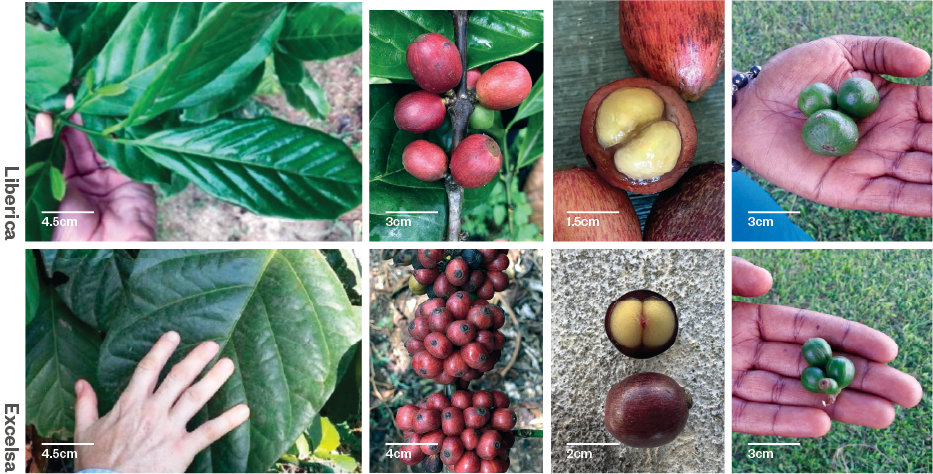
Images showing key differences between Liberica and Excelsa, including (from left to right): leaf size, fruit clustering, fruit structure, and immature fruits. Images sourced from Davis et al., “Genomic Data Define Species Delimitation in Liberica Coffee with Implications for Crop Development and Conservation.”
Resolving the Identity Crisis: Liberica as Three Species
One of the fundamental questions concerns the biological identity of Liberica. What is Liberica coffee? How should it be classified and what characteristics separate Liberica and Excelsa? Most botanists and coffee researchers have accepted a classification that recognizes one species for Liberica, with two botanical varieties, Coffea liberica var. liberica, for Liberica, and C. liberica var. dewevrei for Excelsa. A few botanists do not see the need to recognize any varieties, believing that Liberica represents one very variable species. Others take the historical viewpoint, from the early twentieth century, in recognizing two species, C. liberica and C. dewevrei. Throughout the coffee value chain, there has been a tendency to call everything Liberica, although some readily distinguish both Liberica and Excelsa, for example in the Philippines. Overall, uncertainty and ambiguity have prevailed. As Liberica, and particularly Excelsa, become increasingly more widely available to the consumer, clarity on this matter has become paramount.
With the advent of new DNA sequencing technology, we have been able to tackle this question.[3] Using an approach called target capture, we have been able to sequence 350 genes, and 2,000–14,000 single-nucleotide polymorphism (SNP) markers for each sample. This approach has two major advantages: it produces substantial quantities of DNA data, providing excellent resolution for resolving the relationships between species, populations, and even individuals; and we can use samples from historical museum collections (including those that are hundreds of years old). In addition, these methods are repeatable across all coffee species, new samples can be added when required, and they can be made publicly available for use in other studies.
The conclusion of our genomic study[4] is that Liberica, in the broad sense, is neither one nor two species, but three: C. liberica (Liberica), C. dewevrei (Excelsa), and C. klainei. These species are easily and unambiguously separated from one another based on DNA data. Importantly, the DNA data corresponds to discrete differences in morphology and aligns with the wild geographical distribution of these species.
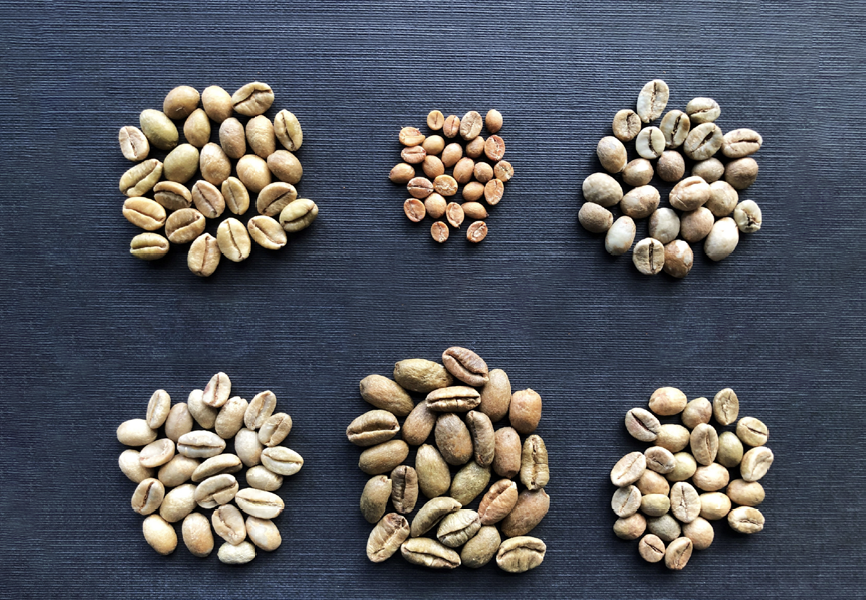
Examples of unroasted Excelsa, Eugenioides, Robusta, Arabica, and Liberica beans after post-harvest processing. Image sourced from Davis at al., 2023.[5]
This matters, because names provide access to information; for example, named Arabica varieties tell us about flavor profiles, origins, and farming requirements. To start with, Liberica and Excelsa have different climate and elevation requirements and ranges in the wild, which translate to where they can be successfully farmed. Under optimum conditions, Excelsa has a distinctly higher cherry and green coffee yield, compared with Liberica. With the revised species definition in place, telling the two species apart is easily undertaken at any stage of the flowering–fruiting cycle. The larger leaves, greater number of flowers and fruits, smaller fruits and seeds, thinner parchment, and fewer lobed flowers easily set Excelsa apart from Liberica.
The flavor profiles are also different: Liberica coffee is dominated by tropical fruits, and Excelsa by tart fruit notes, chocolate, and spice. Both species produce sweet coffee, with medium body and acidity, and a caffeine content close to Arabica. Due to the size, shape, and density of the seeds, roasting requirements are different. There are also likely differences in post-roast resting time and storage behavior for green and roasted coffee. We still have much to learn about these two species. What we have also been able to ascertain is that Liberica is a rare plant in the wild, restricted to forest areas in rather few countries of Upper West Africa, namely Sierra Leone, Liberia, Côte d'Ivoire, Ghana, and Nigeria. On the other hand, wild Excelsa is found across Central Africa, in the Republic of the Congo, Cameroon, the Democratic Republic of Congo, the Central African Republic, South Sudan, and Uganda. The indigenous ranges of the two species do not overlap. Coffea klainei, a very poorly known species, grows wild in West-Central Africa, in Cameroon, Gabon, the Republic of Congo and the Cabinda exclave of Angola. With C. dewevrei and C. klainei reinstated, the total number of known coffee species increases from 131 to 133. Cameroon gains two species (now 18 species in total) and becomes the African country with the second highest number of indigenous species, followed by Tanzania (17 species), and behind Madagascar with 67 species.
Genetics and Sensory Characteristics: Lessons from Stenophylla
With the biological identity and key characteristics of Liberica and Excelsa elucidated, we can now move forward with other lines of scientific inquiry. The next steps for the team are further DNA analysis, climate profiling, and metabolomics. Metabolomics, a new field of "omics" research, enables researchers to undertake a comprehensive review of the biochemistry of an organism or biological system. Recently, we used this approach to study Stenophylla coffee (C. stenophylla).[6] Stenophylla coffee, an undomesticated species from Upper West Africa, is of commercial interest because of its heat and drought tolerance and its capacity to produce superior, Arabica-like coffee.
To investigate the chemical basis of flavor similarity between Stenophylla and Arabica and Robusta, we analyzed unroasted coffee bean samples using liquid chromatography–mass spectrometry (LC–MS) and applied metabolomics approaches to compare chemical profiles.[7] Several hundred compounds were retrieved in the chemical analysis, but we focused on 37 associated with coffee flavor. We found similarities between Arabica and Stenophylla in the relative levels of several key compounds linked to coffee flavor, including caffeine, trigonelline, sucrose, and citric acid. Despite having an almost indistinguishable flavor to Arabica coffee, many differences in chemical profiles were observed, especially in their diterpenoid and hydroxycinnamic acid profiles. For Stenophylla, the dissimilarities in chemical compound composition (compared with Arabica) may offer opportunities for a better understanding of the chemical basis of high-quality coffee and sensory diversification.
An additional novel discovery was that theacrine occurs in Stenophylla, which is the first record of this alkaloid in coffee beans. Theacrine was first isolated from plants as crystals in the residues left over after decaffeinating considerable amounts of tea. Other studies have associated theacrine with improving cognitive performance but, unlike caffeine, without habituation. We are now applying these analytical chemical methods to Liberica and Excelsa, to better understand chemical diversity between, and within, these two species. There is still much to explore in these and other underutilized coffee species, no doubt with further surprises along the way.
Growing Recognition: Liberica and Excelsa's Role in Specialty Coffee
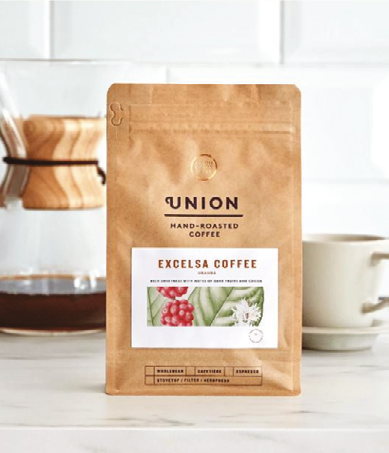
A retail bag of Excelsa coffee, grown in Luwero District, Uganda, roasted by coffee roasters Union in the United Kingdom. This coffee is a product of collaboration between farmers in Luwero, partners in Uganda (NARO, Makerere University, and KCL), as part of the Liberica Coffee Development for Climate Resilience and Sustainability.[8]
2025 was a noteworthy year for Liberica and Excelsa, with more producers coming into play and the diversity of offerings for these species increasing markedly. They also achieved success in barista and roasting competitions. Both species featured in coffee symposia and meetings. At Let's Talk Coffee, Peru, specialty Excelsa from Vietnam's 96b and the South Indian Coffee Company (SICC) were showcased by Blue Bottle Coffee. Then in Kuching, Sarawak, both Liberica and Excelsa were prominent at the Second Borneo Coffee Symposium, a major Southeast Asian coffee event organized and run by Earthlings Coffee. Liberica and Excelsa were the focus of several presentations, appeared on several cupping tables, and were available on brew and espresso bars.
The symposium also hosted the world's first Liberica Brewing Competition, organized by Earthlings founders and Liberica pioneers Kenny Wee Ting Lee and Raven Kwok. Justin Metcalf, acting as Mediator and Head Judge of the competition, summed up the current situation: "Liberica and Excelsa are not fringe species. They are expressive, resilient, and culturally meaningful coffees that have long been overlooked simply because the frameworks to understand them didn't exist. Now that those frameworks are emerging, it's time for the global industry to recognize their place in the broader specialty landscape."
DR. AARON DAVIS is a professional botanist and an established scientist, specializing in wild coffee species, climate change assessment and adaptation, and coffee agroecology.
References
[1] Aaron P. Davis, Catherine Kiwuka, Aisyah Faruk, Mweru J. Walubiri, and James Kalema, "The Re-Emergence of Liberica Coffee as a Major Crop Plant," Nature Plants 8: 1322–1328 (2022), https://doi.org/10.1038/s41477-022-01309-5. Available to read via ReadCube at https://rdcu.be/c1GZf.
[2] Aaron P. Davis, Catherine Kiwuka, Aisyah Faruk, and John Mulumba, The Wild Coffee Resources of Uganda: A Precious Heritage (Royal Botanic Gardens, 2023), https://www.kew.org/sites/default/files/2024-01/The%20Wild%20Coffee%20Resources%20of%20Uganda.pdf.
[3] Aaron P. Davis, A. Shepherd-Clowes, M. Cheek, J. Moat, D. Wei Luo, C. Kiwuka, et al., "Genomic Data Define Species Delimitation in Liberica Coffee with Implications for Crop Development and Conservation," Nature Plants 11: 1729–1738 (2025), https://doi.org/10.1038/s41477-025-02073-y.
[4] Davis et al., "Genomic Data Define Species Delimitation in Liberica Coffee."
[5] Aaron P. Davis, Catherine Kiwuka, et al. "A review of the indigenous coffee resources of Uganda and their potential for coffee sector sustainability and development," Frontiers in Plant Science 13, (2022), https://doi.org/10.3389/fpls.2022.1057317.
[6] Eliot Jan-Smith, Harley Downes, Aaron P. Davis, Adam Richard-Bollans, Jeremy Haggar, et al., "Metabolomic Insights into the Arabica-Like Flavour of Stenophylla Coffee and the Chemistry of Quality Coffee," npj Sci Food 9, article no. 33 (2025), https://doi.org/10.1038/s41538-025-00398-8.
[7] Jan-Smith, et al.
[8] You can read more about the project at Royal Botanic Gardens, Kew, Excelsa and Liberica Coffee Development, https://www.kew.org/science/our-science/projects/excelsa-and-Liberica-coffee-development, accessed Jan 03, 2026.

We hope you are as excited as we are about the release of 25, Issue 25. This issue of 25 is made possible with the contributions of specialty coffee businesses who support the activities of the Specialty Coffee Association through its underwriting and sponsorship programs.Learn more about our underwriters here.