Dialing In, Decoded: How Electrochemistry Helps Us Understand Espresso Extraction | 25, Issue 25

The SCA’s Content Development Manager, Laurel Carmichael, speaks to researchers at the Hendon Coffee Lab about their chemistry lab that looks like a café, and about how they use electrochemistry and Design of Experiments to better understand the complexities of espresso extraction.
Photo credits: Hendon Coffee Lab

Introduction by JESS RODRIGUEZ, SCA Coffee Features Events Manager
“You have to taste a lot of bad espresso to appreciate the good” is the mantra I’d repeat over and over to myself as I made endless micro-adjustments on the grinder, chasing that perfect shot.
The following feature about research into espresso extraction instantly transported me back to my early barista days: Standing in front of an espresso machine, fixating on which variable change it was going to be that would redeem the last six poorly extracted shots. The memory is almost visceral—the tension, anticipation, and frustration all mingling together. It seems this is an all-too-familiar experience for most baristas. Whether these memories are traumatic or nostalgic, well, that’s the beauty of perspective.
But what if world-class research could give us better insights into what changing different variables will achieve, meaning we don’t have to taste countless espresso shots to understand what’s happening in the cup? What if research findings could help us to be more strategic with the “dial-in game”?
In this feature, we’re introduced to a one-of-a-kind research environment, the Hendon Coffee Lab at the University of Oregon, and a team hard at work using a combination of electricity and chemistry (electrochemistry) to measure what’s actually in our espresso shots.
What sets the Hendon Coffee Lab apart is its dual identity. It’s both a cafe and a research lab, blending everyday cafe challenges with scientific exploration.
The research, aimed at quantifying the chemical compounds in espresso coffee and how they’re extracted, is being conducted in a similar environment to the cafe that first sparked my curiosity for coffee. The cafe environment that has inspired a lifelong love of coffee in so many of us and cultivates a drive to learn, experiment, and share more with others. It felt fitting to read that many of the research’s key features—such as the embrace of Design of Experiments—were the result of conversations between researchers and visitors to their coffee bar.
Whether you’re a researcher in a lab, or a barista rushing to dial in before the morning rush, the Hendon Coffee Lab’s research will provide insights for your work. Their team’s enthusiasm for sharing coffee knowledge is also deeply relatable. Amidst all the challenges of working with something as complex as espresso, one researcher shares, “…it’s worth it to be able to share what we're doing, and see people's faces light up.”
Even though my days behind the bar are long gone, I am one former barista who is eagerly waiting to see what insights come out of the Hendon Coffee Lab.
- JESS RODRIGUEZ is the SCA Coffee Features Events Manager.
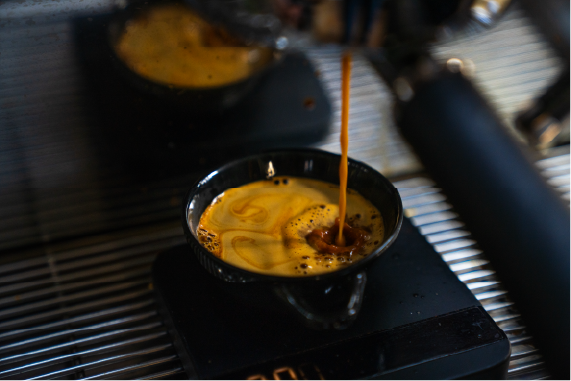
Imagine: You’ve arrived for your barista shift at 07:00 am, bleary-eyed, and have just 30 minutes to dial in the espresso and filter coffee, plus a dozen other tasks before the first customers arrive.
As someone with a keen interest in coffee flavor, you love the process of playing around with espresso recipes to make the coffee taste as good as possible. You know this espresso theoretically has flavor notes of berry fruit, dark chocolate, and floral honey, but you’re wondering how on earth you’re supposed to extract those when it’s currently tasting like sour grapes.
As many baristas reading this will know, you need to be strategic. There are only so many variables (such as grind size, brew time, or temperature) that you can play around with before the first eager customer starts knocking on the door. Sometimes, changing one variable will influence another—such as the grind size influencing the brew time—which makes refining the espresso recipe even harder. In the worst-case scenario, you might also be dealing with uncontrolled variables—frantically pulling shot after shot might make the coffee grinder heat up, impacting grind size and your ability to pull consistent shots. You (and the café’s accountant) don’t love that you’ve now poured 17 double shots down the drain before you’ve even opened the café doors.
As the final, and too frequently forgotten, consideration, you want to avoid tasting too many trial espresso shots. You know from experience that morning over-caffeination makes you frazzled, exacerbated when spoons rattle conspicuously on saucers as you deliver your customers their morning brews.
This isn’t a hypothetical nightmare scenario (although, when I was a barista, I had actual nightmares about this process for years), it’s a daily challenge for coffee professionals all over the world. We have expertise, empirical experience, and some tools, such as refractometers, to guide us through this process. But what if advanced research into coffee extraction could make this task easier for motivated baristas who are essentially conducting multifactor experiments under tough conditions? Can we better understand the complex interactions of many factors like water temperature, pressure, or grind size on the coffee itself? What if we were able to test not only how thick an espresso is (total dissolved solids/TDS) or how much coffee we’re extracting (extraction percentage), but also what we’re extracting from coffee, and do it quickly?
Baristas know that dialing-in espresso can be both deeply satisfying and frustrating. The Hendon Coffee Lab are building knowledge about how different variables influence what we extract and when, helping to demystify the process.
Understanding What We Extract from Coffee
In the spirit of making coffee better (and making making coffee better), espresso manufacturer Simonelli Group approached the SCA with a desire to support cutting-edge espresso research. Together, Simonelli and the Coffee Science Foundation research staff collaborated on a request for proposals for research on espresso quality measurement. One proposal from Professor Christopher Hendon’s Coffee Lab at the University of Oregon stood out. “Professor Hendon’s approach was unique,” said Lauro Fioretti, of Simonelli. “As an engineer, I’m familiar with lots of ways to measure coffee—but Christopher’s ideas were really exciting.”
The Hendon Coffee Lab’s research proposal was unique for two major reasons: their lab is designed to replicate an everyday café environment, and they use electrochemistry to measure coffee. We’ll dive into exactly what electrochemistry is shortly (don’t worry), but let’s first visit their lab.
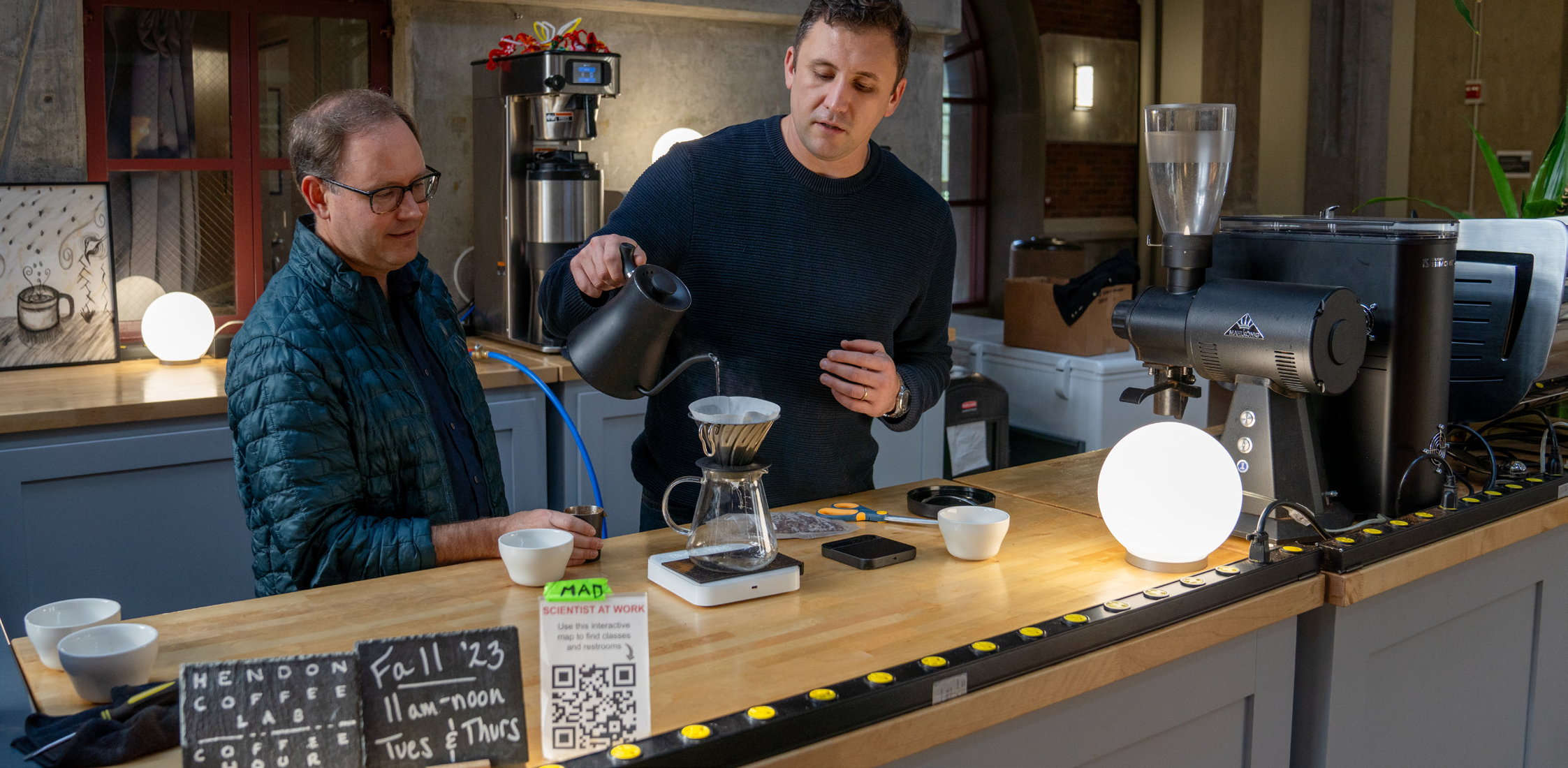
Christopher Hendon (right) with Professor Josef Dufek, University of Oregon Head of Earth Sciences at the Hendon Coffee Lab—a space that also functions as a café.
The Lab that Looks Like a Café
You’ll find the Hendon Coffee Lab in the middle of an atrium in the science building at the University of Oregon. However, if you’re looking for test tubes and lab coats behind key code doors, you might not spot it initially. You’d be forgiven if you don’t realize that the café—where undergraduate student Laurel Wood is talking excitedly to a customer about a new co-fermented espresso; PhD candidate Doran Pennington is poring over data on the couch; and students, custodial staff, visiting parents, and professors are milling about chatting—is actually a world-class chemistry laboratory.
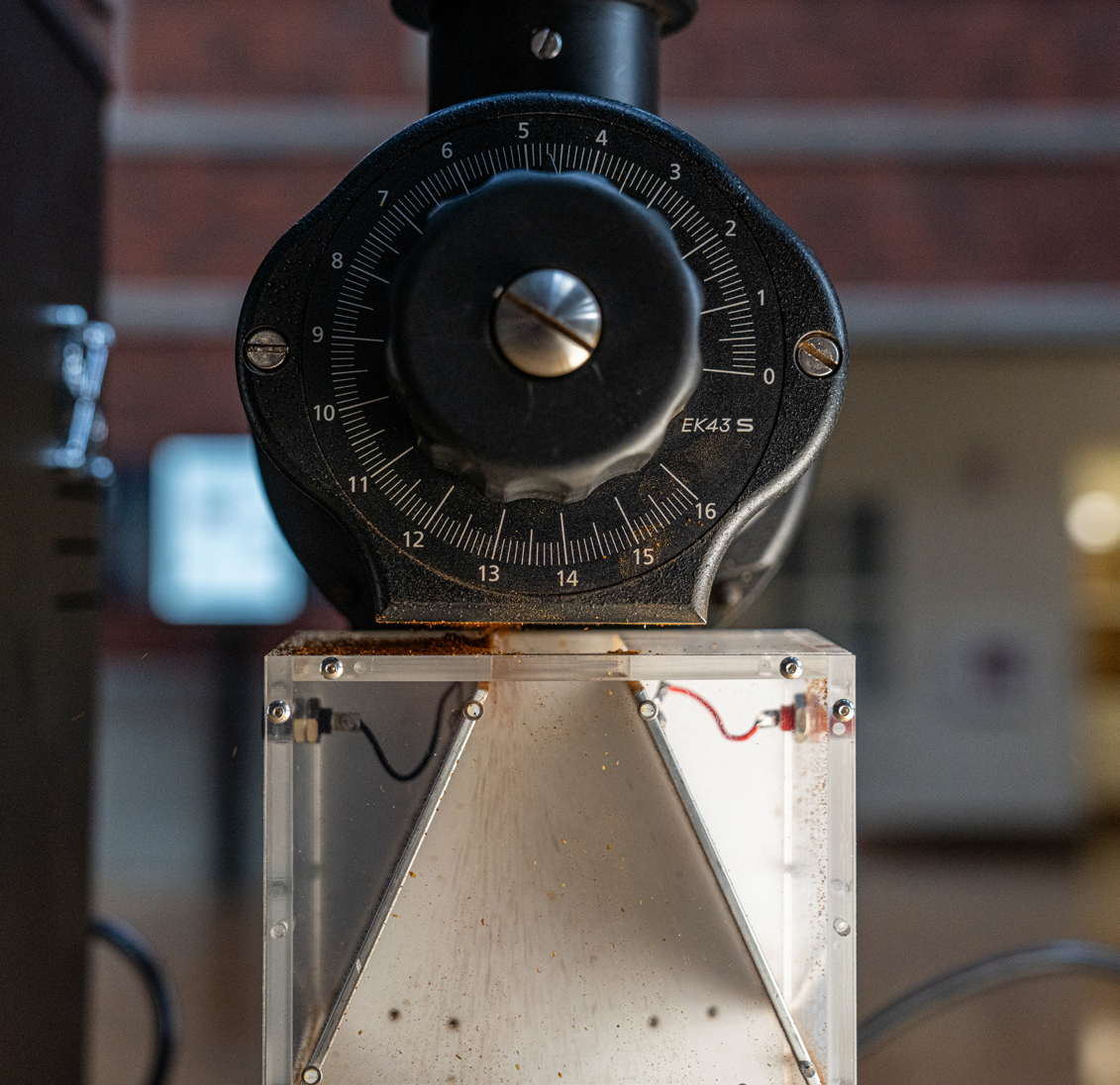
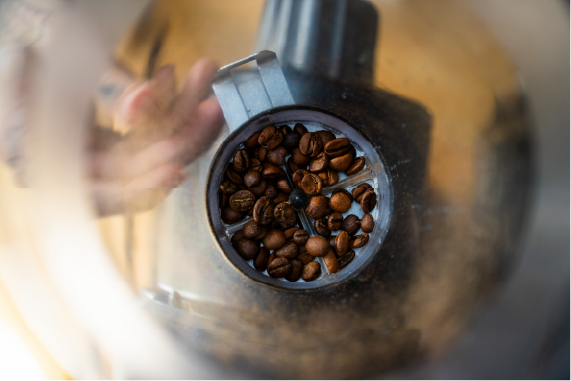
One of this project’s unexpected research avenues was on static electricity generated during coffee grinding.
The lab, opened after the COVID lockdowns, was designed to facilitate the social engagement that Christopher noticed many of his students and fellow staff were missing. The lab runs a twice weekly “coffee hour” where people come by, drink coffee, and chat. The coffee hour, he shares, “captures the atmosphere and the attitude that we’ve tried to cultivate in the lab, which is: the best way to learn about coffee is to work with it, or to talk to someone who is [working with it].” This environment of open learning and exchange has encouraged the lab team to think outside the box with coffee research, often opening new avenues for investigation. For example, the team’s research into the static electricity generated by coffee grinding and its impact on espresso extraction[1] was inspired by a volcanologist who, during coffee hour, was describing research on static electricity and dust on Titan (one of Saturn’s moons).
Dr. Robin Bumbaugh, a recently graduated PhD, shares that the lab’s design means the team must balance a public-facing role with the need to conduct concentrated work—a reality that every barista understands. One trick that Robin mentions was “to think about the way I was facing. If I really needed to concentrate, I’d have my back facing the bar, but at other times I’d welcome discussions with everyone.” Daily conversations in the lab, she continues, are a great chance to practice discussing our work with a wide variety of audiences, “understanding the level of specificity that each person is interested in.” “The public-facing aspect of the space can be intense,” says Laurel, “but it’s worth it to be able to share what we’re doing, and see people’s faces light up.”
The “real life” design of the lab has another big advantage. Remember how our everyday barista was frustrated by uncontrollable variables—such as the grinder heating up, or the ambient humidity and temperature changing throughout the day? Dealing with these systemic challenges is a huge part of brewing coffee in real-life settings, but they’re not factors that researchers would normally encounter in a lab, and they’re often not considered in scientific experiments. “Running a lab in a café has allowed us to experience and tackle real problems,” says Christopher, “not miss them, or retrospectively try to simulate them.”
Electrochemistry: Using an Old Tool to Measure Coffee
One clue that might give away that the Hendon Coffee Lab isn’t quite an ordinary café is that the “baristas” aren’t using standard tools, such as refractometers, to measure the coffees they’re extracting. Instead, they’re using a method known as electrochemistry:[2] essentially passing electricity through the coffee liquid and interpreting how the molecules within the brew respond. Electrochemistry has been studied for over 100 years and is used today in lithium-ion batteries and in the pharmaceutical industry. It’s also widely used to measure dirty water, which (aside from obvious sensory differences) isn’t all that different to coffee—it contains a complex mixture of chemical compounds or molecules.
Electrochemistry (explained in an earlier 25 feature in more detail)[3] uses essentially the same principle that our tongues use—detecting electrical signals based on the presence of certain molecules. Electrochemistry works by passing an electric voltage through the liquid, which makes organic molecules temporarily lose or gain electrons—processes known as oxidation and reduction, respectively. The movement of electrons generates current, which the researchers can measure by inserting metal probes (electrodes) into the coffee. Because certain parts of each molecule (known as functional groups) respond to electricity in certain ways, measuring current allows them to detect the presence and concentration of molecules (such as caffeine, chlorogenic acids, or organic acids) in the liquid coffee.
The key here is that electrochemistry can tell us about the chemical composition of a coffee liquid. This is a big jump from refractometers, which use visual readings to tell us the amount of (but not composition of) dissolved solids in a liquid, and more complex methods such as chromatography, which use extremely expensive tools in complex laboratories.
Professor Benjamín Alemán explains how this works: Electrons (particles with a negative electric charge) in molecules can only exist at specific energy levels—they can’t float in between. Imagine that the positions of the electrons are like steps in a staircase (fixed, specific points) and that each molecule has a unique staircase design with different heights of each step. For example, chlorogenic acid has one staircase design, caffeine has another. When you use the electrodes to pass electricity through the coffee liquid, you can set the voltage to a certain “step.” As electrons exchange energy with the electrode, the voltage tells you what type of “staircase” or molecule is present in the liquid.
What excites Christopher most is that the measurements are almost instantaneous—you can get a reading within 0.01 seconds, “faster than many scales report.” What’s more, the drinks don’t need to be diluted, and you don’t even need a pipette. “The industry doesn’t need a ten-step procedure to measure coffee,” he continues. “We need to be able to make real-life measurements on real-life drinks.” Being able to measure the chemical composition of coffee quickly and affordably means the team can really investigate the big questions that will guide better coffee extraction, such as: “How does shot time impact the ratio of organic acids to other compounds?” “Does a darker roast change what extracts at different points during a shot’s extraction?”
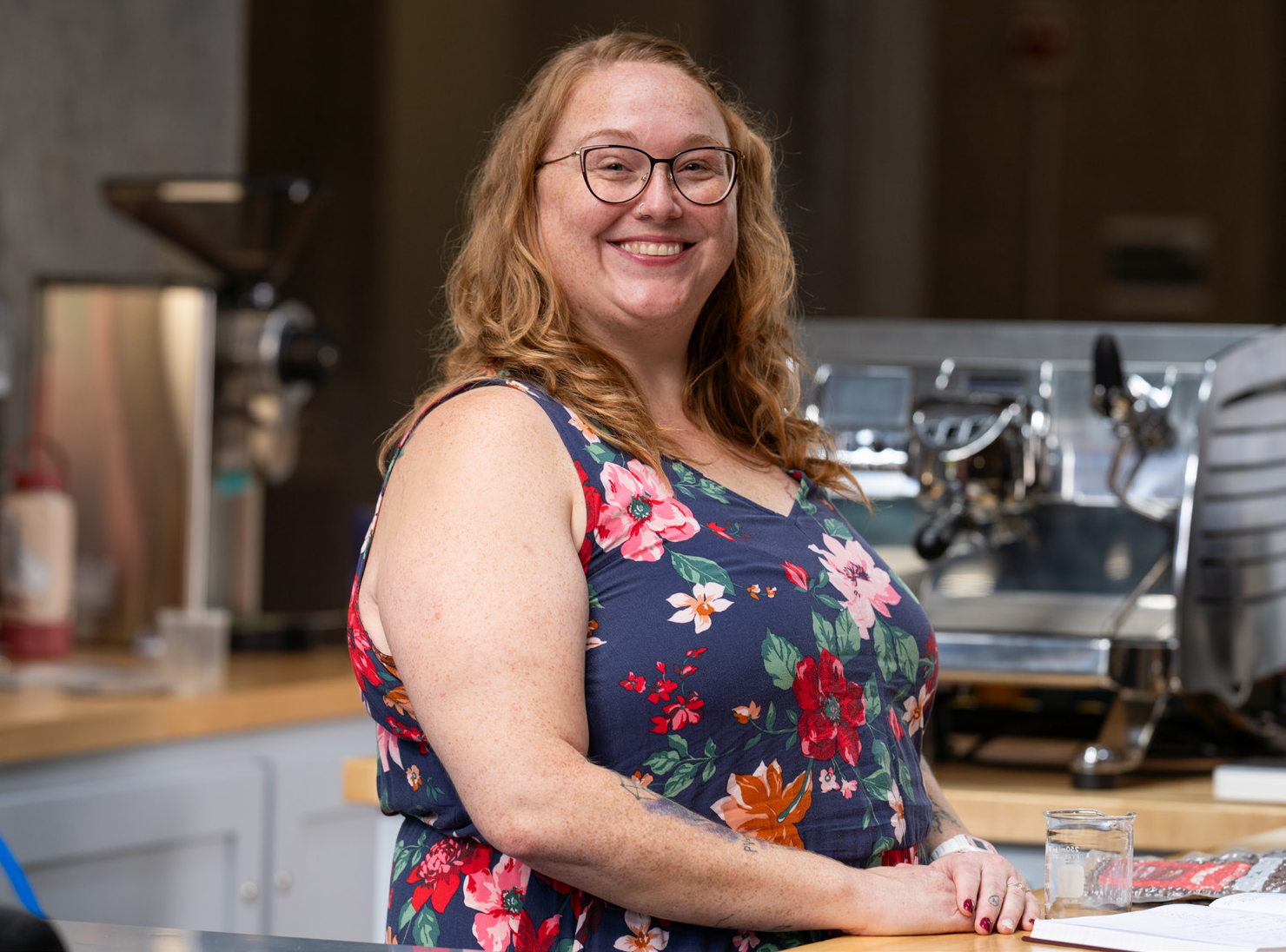
Dr. Robin Bumbaugh shares that the unique setting of the lab was a great opportunity to practice science communication, including understanding the level of specificity each visitor was interested in.
“Electrochemistry,” Christopher says, “is about being able to tell you what’s in the cups you like, and some steps for how to get there.”
Using Design of Experiments for Better Insights
Using electrochemistry means that the researchers can gather valuable data readings fast, but—remember—they’re still pulling shots using the same tools as an ordinary café. Just like baristas trying to create a delicious espresso during their morning dial-in, this means that they want to change one thing at time. The challenge with this is that there are lots of variables to consider and these variables interact. For example, a hotter water temperature won’t just extract different chemical compounds, it also changes how fast the water moves through the espresso puck, influencing the brew time, which in turn influences the chemical composition. This usually means that baristas have to make informed, but ultimately speculative, decisions about exactly what’s influencing changes in the cup.
This is why, at the Hendon Coffee Lab, the team have embraced something known as Design of Experiments (DOE). In another example of the cross-departmental collaboration that results from coffee hour chats, DOE came to the team via discussions with Benjamín from the physics department. At its core, DOE involves a smart and effective selection of experiments to run, randomizing the order in which they’re conducted, and then using statistical modeling to gather advanced insights from the results. As well as choosing smart experiments to run, the randomization is especially important for coffee settings—remember how our morning barista was dealing with systemic challenges such as the grinder overheating? If the researchers were to change just one variable at a time—for example, water temperature—at consecutive intervals—say, 88 °C to 96 °C in 2 °C increments—while the grinder gradually heats up, the unintended impact of the grind changes would influence the shots with hotter water temperature more, leading to false conclusions. Randomizing the order in which the variables (in this case, the water temperatures) are deliberately changed spreads the potential errors across the whole data set, meaning they don’t distort the results.
DOE’s mathematical modeling of the gathered data also allows researchers to evaluate interactions between different variables. It allows for interpolation—using models to accurately predict new data points based on the range of known data points. Robin sees DOE as a particular strength of their lab: “Coffee’s chemical composition is influenced by multiple factors, such as pressure, time, mass of coffee, and the basket shape—just to name a few. When you add in the interactions of these variables, you’d normally need to pull thousands of shots to understand how these factors influence the cup.” With DOE, not only do you need to test fewer shots (for example as few as 16 shots for a five-factor experiment), Christopher adds, but the information you can gather from them is of a much higher quality. For example, Robin highlights an upcoming paper on cupping brewed coffee, where they share that it was not individual variables (such as water volume or water temperature) but the interaction of those variables that had the most impact on the cup—insights that wouldn’t have been possible without DOE.
Bringing Electrochemistry to the Coffee Sector
Christopher is clear that, for now, the aim isn’t to design an electrochemistry device that everyone can use in their cafés—although that may be an outcome of the research longer term. Rather, it’s to build up an encyclopedia-like pool of validated knowledge on how different factors impact coffee extraction and the chemical composition of coffee. For example, their finding that spritzing beans with water before grinding can help reduce clumping and improve extraction[4] was already practiced in the sector and written about on Reddit, but it had never been scientifically validated. Now that it’s been validated by Hendon’s team, future researchers can use this technique to avoid this particular systematic error in their experiments, leading to better research. Laurel shares that she’s conducting research into using electrochemistry to build water for coffee. She’s learning that—because the salts we use to build water are hygroscopic (they absorb water from the air)—weighing them is not a reliable way to add precise quantities to water. Every salt, however, has a different conductivity and she’s exploring how to use the conductivity meters found on some basic TDS meters to measure the concentrations of salts in water in real time.
At a time when we’re discussing what “quality” in coffee means, electrochemistry gives us lots of opportunities to identify precisely what chemical compounds we associate with certain qualities (or attributes) and what factors we can change to extract these compounds in the cup.
“Electrochemistry,” Christopher says, “is about being able to tell you what’s in the cups you like, and some steps for how to get there.” Especially important, he reminds us, is that electrochemistry reflects the way we actually taste and smell coffee: we perceive the cumulative impact of multiple molecules, rather than isolated ones. Electrochemistry works in the same way, giving us information about molecules and their ratios in the liquid.
Interviewing the Hendon Lab’s team for this feature, I was struck by how genuinely excited each person is about this work. The excitement is grounded in aspects of the research that every barista can relate to. Electrochemistry allows us higher resolution into what coffee actually contains, beyond extraction percentage or TDS. “We know that flavor and aroma don’t simply arise from one molecule,” shares Robin. With electrochemistry, “we look at the complex mixture and probe to understand the chemical compositions that we like.”
The Hendon Lab’s research reflects and complements very human interactions with coffee—our tongues work like an electrochemistry meter, and our brains do complex calculations to interpret that information, similar to DOE software. This research can help to validate what we taste with objective information, better explaining exactly why one shot tastes different to the other. This is exciting for that morning barista who loves tasting and understanding coffee’s complexity but might prefer to pull and taste 5 interesting espresso shots at 07:15 am, instead of pouring 17 down the drain.
LAUREL CARMICHAEL is the SCA Content Development Manager and a former roaster and barista who strives to better understand how espresso recipes and coffee roast profiles influence what we can extract in the cup.
References
[1] You can read more into their research on static electricity and coffee grinding at Joshua Méndez and Christopher H. Hendon, “It’s Electric: Understanding—and Reducing—Static Electricity During Grinding,” 25, Issue 21, https://sca.coffee/sca-news/25/issue-21/its-electric-understanding-and-reducingstatic-electricity-during-grinding.
[2] Christopher Hendon, “Towards a Deeper Understanding of Espresso Extraction,” Re:co 2023, https://www.youtube.com/watch?v=F5bti_SN0cg.
[3] Christopher Hendon, “Amped Up: Using Electrochemistry to Detect and Quantify Molecules in Brewed Coffee,” 25, Issue 18, https://sca.coffee/sca-news/25/issue-18/amped-up-using-electricity-to-detect-and-quantify-molecules-in-brewed-coffee.
[4] Joshua Méndez Harper, Robin E. Bumbaugh, and Christopher H. Hendon, “Strategies to Mitigate Electrostatic Charging During Coffee Grinding,” iScience, 27, Issue 9 (2024), https://doi.org/10.1016/j.isci.2024.110639.
We hope you are as excited as we are about the release of 25, Issue 25. This issue of 25 is made possible with the contributions of specialty coffee businesses who support the activities of the Specialty Coffee Association through its underwriting and sponsorship programs.Learn more about our underwriters here.