

Coffee Decoded: Smellwords
Welcome to Coffee, Decoded, the Specialty Coffee Association’s weekly column on science, research, and all things coffee knowledge. Each week, PETER GIULIANO answers complex coffee questions, interprets new research, and dives deep into the science, putting it all in a fun, understandable format.
Our senses of smell and of taste are closely linked; we detect them in organs connected to each other (our nose and mouth), they both detect chemicals in the environment (they are together called “the chemical senses”) and our brains combine them to create the experience of “flavor.” However, the two senses are different in some very fundamental ways. We can see this most clearly in the language we use to describe them.
Our primary words for basic tastes are very specific: sweet, sour, salty, bitter, and umami. These words describe the experience of taste directly: “sour” means a specific stimulus, caused by acid on the tongue.
Our words for smell are a completely different story. Most languages have very few direct words for smells. In English, these words are kind of vague: “stinky” or “fragrant.” To describe smells, we generally use source or comparison terms: “it smells like onions in here,” or “your shirt smells like perfume.” We perceive many, many more smells than tastes, but ironically, we have fewer vocabulary terms for them. This is a widely observed phenomenon across many languages. There are exceptions—certain indigenous languages of Malaysia[1] and Thailand,[2] famously, have many more direct olfactory terms than other languages (about 12), but even still these terms are fewer than the thousands of stimuli our noses can perceive.
It is perhaps because we can smell so many chemicals that we lack specific words for them. Since we can quickly identify the smell of, say, jasmine, there is a tremendous benefit in calling it out specifically. This leaves us with a tremendous number of smellwords, often metaphorical, comparative, or source-based.
What does this mean for coffee? Well, it makes the act of describing coffee—which we do constantly in the specialty world—a little bit of a minefield. To begin with, we must be clear we are usually using comparison words, not source words. When we say a coffee is “floral” or has “notes of peach,” we’re not saying it literally has flowers or peaches, we’re saying it has aromas that remind us of flowers or peaches. Usually. Sometimes we DO mean to describe the source of the smell—when we describe a coffee as “fermented” or “underripe.” This, of course, can create confusion for those not schooled in the language of the coffee taster: does a coffee that is described as having “notes of almond” have nuts in it or not?
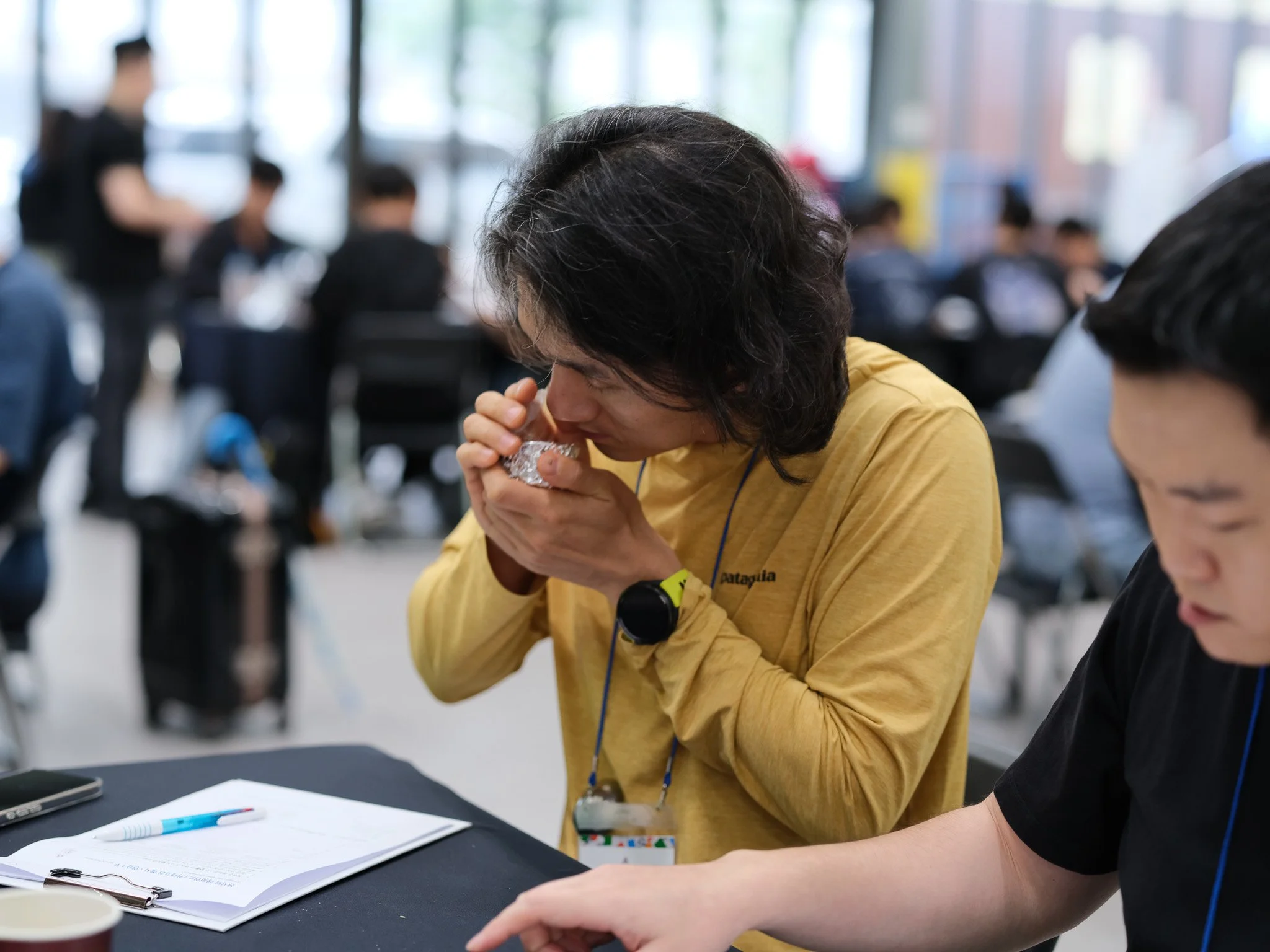
Attendees at an Intro to Cupping Workshop practice smelling olfactory examples. These are food or other items with smells similar to those commonly found in coffee, such as dark chocolate or jasmine tea. The SCA has a list of olfactory examples here with instructions for how to prepare and practice with them.
Secondly, since coffee is so complex, we have a ton of terms to describe. And many of them rely on our experience as humans—if you’ve grown up eating mangoes, you’re likely to use that term to describe a coffee’s fruit-like aroma, but if you’ve never had a mango you just can’t.
It’s for this reason that the coffee industry has built a shared vocabulary for the coffee trade. In 1922, William Ukers included about 30 coffee flavor terms in his foundational text All About Coffee. In the early 1980s, Ted Lingle wrote The Coffee Cupper’s Handbook, and included 161 flavor terms. In 2015, World Coffee Research and Dr. Edgar Chambers created the WCR Coffee Lexicon using a more systematic approach, and wound up with 110 terms, many of them smellwords; this lexicon was the source document for the SCA/WCR Flavor Wheel. This document made a big step forward. For the first time, every term had a “reference” associated with it; a specific substance a person could smell to learn the meaning of the term, even if they had previously never encountered it. The SCA and WCR have recently announced their intention to revise the lexicon and wheel with a more global perspective, trying to include fewer country-specific terms and more universal ones.
But it won’t be perfect—smellwords never are. They are a way our brain deals with the many chemicals we encounter in nature, in all of their beautiful complexity.
- PETER GIULIANO the SCA's Senior Advisor for Scientific Communication.
[1] N. Burenhult, N. and A. Majid, (2011). “Olfaction in Aslian Ideology and Language.” The Senses and Society, 6(1). https://doi.org/10.2752/174589311X12893982233597
[2] Ewelina Wnuk, Asifa Majid, (2014). “Revisiting the limits of language: The odor lexicon of Maniq.” Cognition, 131(1). https://doi.org/10.1016/j.cognition.2013.12.008.
Want to learn more?
Can We Smell Sweetness?
Peter Giuliano writes about exciting research to explain the phenomenon of sweetness in coffee.
https://sca.coffee/sca-news/coffee-decoded-2-coffee-sweetness
Want to practice?
You can use this library of Olfactory Examples to practice identifying common fragrances, aromas, and flavors commonly associated with coffee. This is a great way to work with your team to practice using a common language to describe what you smell.