

Welcome to Coffee, Decoded, the Specialty Coffee Association’s weekly column on science, research, and all things coffee knowledge. I’m PETER GIULIANO, and each week I answer coffee questions, interpret research, and dive deep into coffee science.
We all know it—the compelling, delicious, amazing, enticing smell of coffee. It delights us in sometimes surprising moments. You might wake up in an upstairs bedroom and instantly know coffee is being brewed in a downstairs kitchen just because of the smell. Or you might be walking down the street and detect the fragrance of a coffeehouse even before you see it. Or it might be simpler and more personal—the familiar aroma of a favorite origin or roast. The smell of coffee is magical: It can cross great distances, it can fill a room, and it can instantly signal a coffee’s origin, roast level, or freshness.

But how does it work? How is it possible we can smell coffee from so far away, and with such accuracy?
The main concept at work is volatility, which is the tendency of a chemical to become a gas. As we might remember from high school chemistry class, most chemicals can exist in different phases depending on their temperature. For example, water is in its solid phase (ice) below 0 degrees C, it is in its liquid phase (water) between 1-99 degrees C, and it generally becomes a gas (steam) at 100+ degrees C. However, sometimes, a substance can transition into its vapor stage while still below its boiling temperature. When a substance has a tendency to do this, we say it has high volatility. Water is like this; it can evaporate into the air even at room temperature.
But water isn’t the only volatile chemical in the world. Many compounds, especially light, small molecules, readily become vaporized, especially when a little energy is added to the equation. Here’s a great example: acetic acid (better known as vinegar) is a small, light, highly volatile molecule. Open a jar of vinegar and you can smell the acetic acid from across the room. Citric acid, meanwhile, is a larger, heavier molecule with low volatility. You can’t smell citric acid at all.
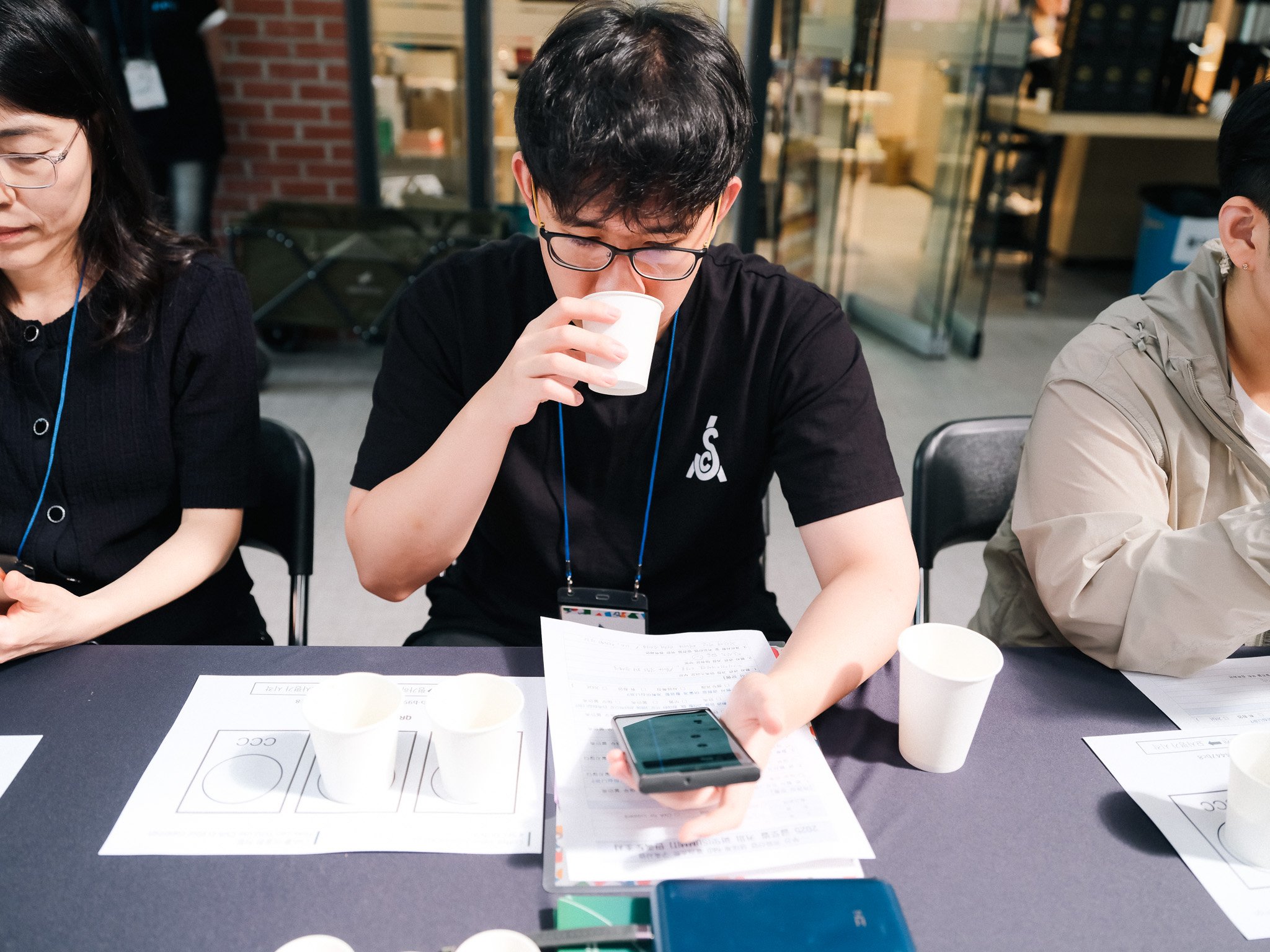
Luckily, coffee is loaded with highly volatile compounds.[1] Add a little bit of energy—like grinding coffee beans or brewing grounds with hot water—and those molecules launch into the air. Light, small aroma molecules diffuse incredibly quickly in air, particularly if the air is moving. Smells can cover several meters in just a few seconds.
But this is only half of the story of coffee aroma. To be appreciated by a person, the molecules need to be sensed. Luckily, our bodies are equipped with sophisticated chemical detectors, exquisitely designed to detect smells. Our nasal cavity—the space in our skulls just behind our noses and beneath our eyes—is lined with special olfactory neurons. The tips of these specialized nerves dangle in the air, waiting to detect anything they might encounter. When air is inhaled through the nose or rises from the throat, any floating volatiles stick to the nerves. These nerves bind with the molecules, allowing the nerve to “recognize” the molecule’s physical properties. The nerve then sends a signal directly to the brain, and if the brain recognizes the stimuli—say, it’s a set of chemicals that it’s detected before—the brain interprets it as “coffee.”
The process is astounding when you think about it. A tiny molecule releases from the coffee, it floats through the air like a speck of dust, finds its way into your nose, binds to a nerve which recognizes the molecule. It then sends a signal to your brain, which makes the connection: coffee is brewing. The chain of events is delicate, precise, unlikely, and relies on molecules flying in the air.
That’s the magic of coffee’s aroma.
References
[1] JM Yu, M Chu, H Park, J Park, KG Lee, “Analysis of Volatile Compounds in Coffee Prepared by Various Brewing and Roasting Methods,” Foods, 2021, https://doi.org/10.3390/foods10061347.
Learn More
READ.
Analytical chemist DR. ROBIN BUMBAUGH shares a conversation between her and VIVA LENOIR, the President of Éditions Jean Lenoir, discussing perception and smell in coffee.
Create a free Associate Membership to read the article on the SCA Portal.
READ.
In an earlier Coffee Decoded, PETER GIULIANO dives into the words we use to describe what we smell in coffee.
LEARN.
You can learn about coffee fragrance and aroma in the Coffee Sensory and Cupping Handbook written by PETER GIULIANO and the SCA’s Technical VP, DR. MARIO FERNÁNDEZ-ALDUENDA.