

Coffee Decoded: What is “freshly roasted” coffee?
Welcome to Coffee, Decoded, the Specialty Coffee Association’s weekly column on science, research, and all things coffee knowledge. Each week, PETER GIULIANO answers complex coffee questions, interprets new research, and dives deep into the science, putting it all in a fun, understandable format.
One of the central ideas of specialty coffee is that coffee should be “fresh.” But what do we mean by that?
Etymologically, the English word “fresh” comes from an old Germanic word frisc, referring pure water. “Fresh” water was unspoiled, cool, not salty, and good to drink. Eventually, the word became used for other consumables besides water: “fresh” food or drink was unspoiled and good to consume. Over time, the term “fresh” came to have another meaning: it also could apply to a food that hadn’t sat around for long. “Fresh” bread was not only unspoiled, it was still flavorful and not yet stale.
As humans began to consume roasted coffee, we quickly noticed a parallel with bread. Coffee would lose its flavor after sitting around for a while, just like bread did. Coffee drinkers quickly applied the term “fresh” to good coffee. One memorable example is in the 1909 novel The Rosary wherein a character exclaims:
“Coffee it is not what you make it in; it is how ye make it. It all hangs upon the word fresh—freshly roasted—freshly ground—water freshly boiled. And never touch it with metal. Pop it into an earthenware jug, pour in your boiling water straight upon it, stir it with a wooden spoon, set it on the hob ten minutes to settle; the grounds will all go to the bottom, though you might not think it, and you pour it out, fragrant, strong and clear. But the secret is, fresh, fresh, fresh, and don't stint your coffee.”
So, it’s for good reason that coffee science has investigated the phenomenon of coffee “freshness.”
Early food scientists noticed that heating certain foods until they turn brown created unique aromas along with a big dose of carbon dioxide (CO₂). It eventually became recognized as two closely linked processes: Maillard reactions which create delicious brown aromas and Strecker degradation which creates CO₂. These happen whether making toast for breakfast, toasting barley for beermaking, or roasting coffee. It’s an extremely fortunate occurrence: the gaseous CO₂ becomes a carrier for the aromas, helping them reach our nose. In coffee’s case, the CO₂ becomes trapped in the cellular network of the roasted coffee, keeping it intact for a while. But a little bit leaks out through the cell walls through a process known in coffee as “degassing,” and the coffee loses its aroma. This slow loss of CO₂ is difficult to measure, but several years ago scientists at the Zurich University of Applied Sciences used a super-accurate scale to measure the loss.[1] This is shown in the following diagram, from the SCA’s Coffee Freshness Handbook:[2]
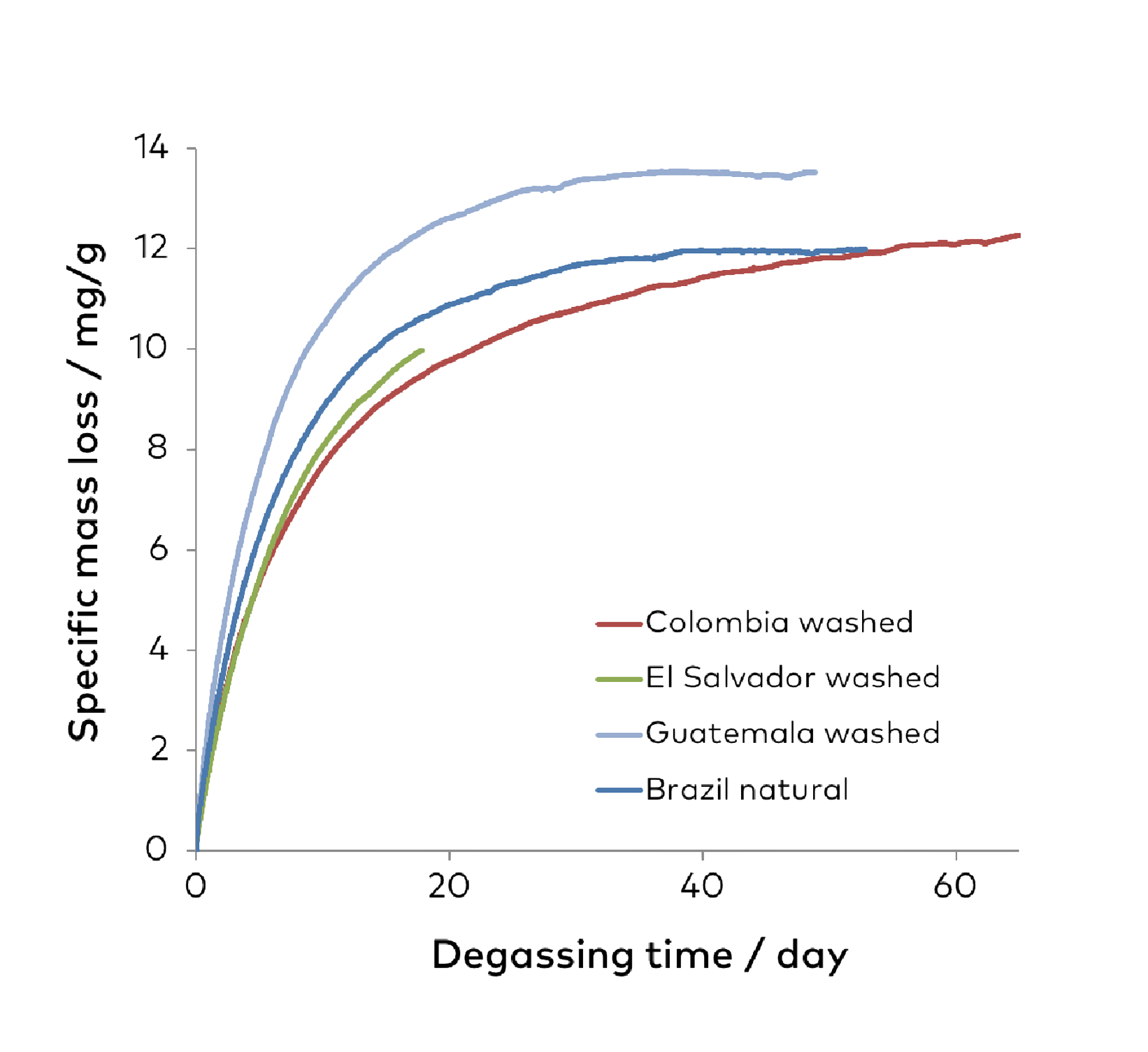
Figure 14 from the SCA Coffee Freshness Handbook. Off-gassing of whole-bean roasted coffee of different origins and processing types. All coffees were roasted on a Probatino, with a green batch size of 1 kg, to a roast degree of 100 Pt.
The vertical (Y) axis shows the loss of CO₂, the horizontal (X) axis the number of days since roast. A rapid initial loss of CO₂ is shown by the steep vertical lines.
As you can see, CO₂ degassing occurs rapidly for the first 20 days after roasting, slowing dramatically afterwards. This illustrates the importance of the first three weeks after roasting: coffee is changing dynamically during this time, losing its aromas quickly.
But there’s more. One feature of carbon dioxide is that oxygen atoms are bonded to carbon—this is good because it means CO₂ can’t oxidize anything. Oxidation is what happens when free oxygen reacts with the oils and aroma compounds in roasted coffee, which can make the coffee taste "off," or even rancid over time. However, as long as CO₂ surrounds and permeates the beans, it keeps oxygen out. Once CO₂ escapes, oxygen-rich air rushes in to take its place, and the coffee starts developing off-flavors.
Grind the coffee and all this happens in fast motion: the CO₂ that is lost over weeks in whole bean coffee is lost in minutes after coffee is ground.
What does all this mean? Well, if you use CO₂ degassing as a guide, whole bean coffee can reasonably be considered “fresh” within about three weeks of roasting. Since ground coffee loses CO₂ much more quickly, it might be considered “fresh” for about an hour after grinding.
- PETER GIULIANO is the SCA's Senior Advisor for Scientific Communication.
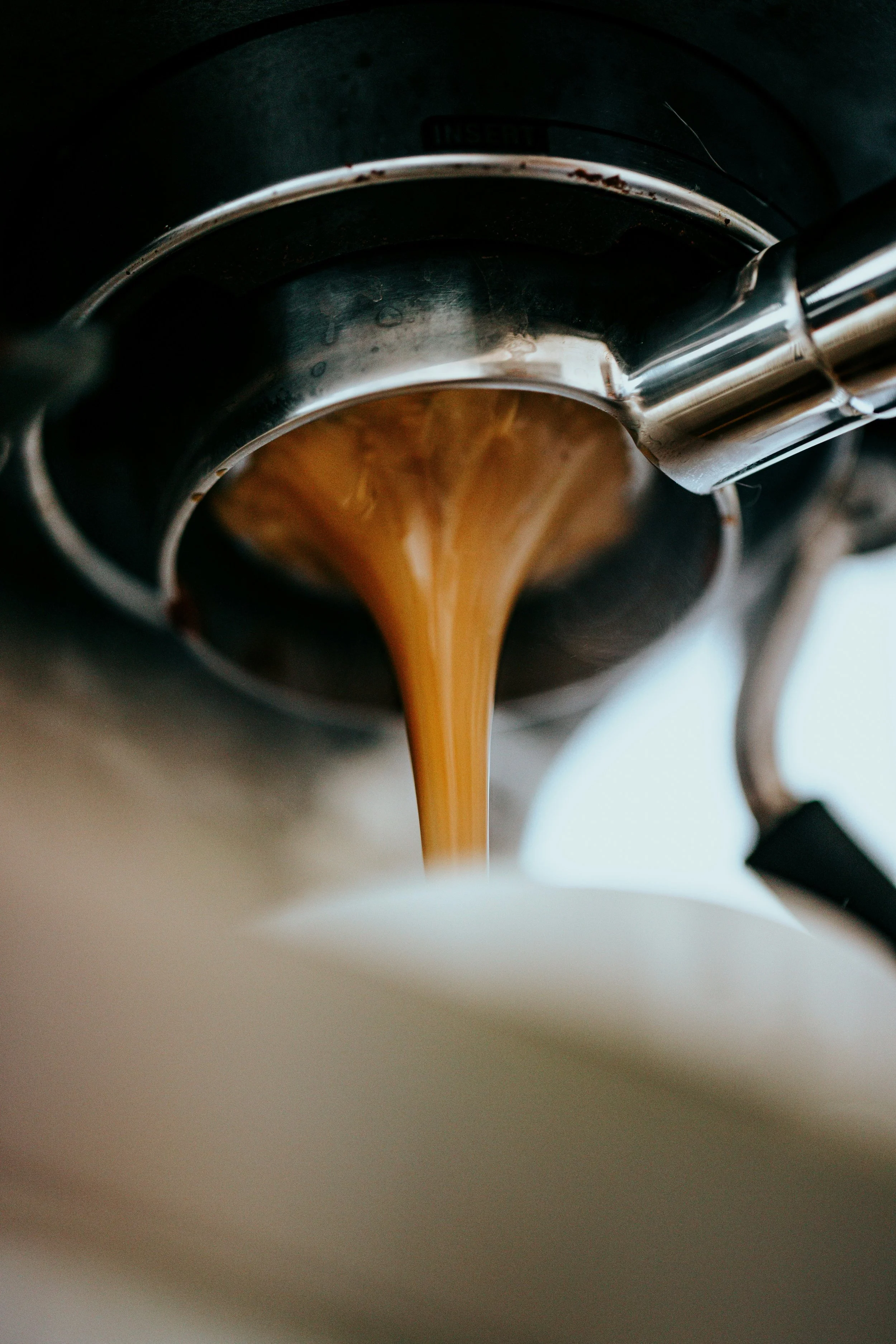
You may have noticed that fresh coffee produces larger amounts of crema during espresso extraction, and stronger blooms during filter brewing. This is due to CO₂ in fresh coffee that is trapped inside the porous structure of the roasted coffee beans which is released during brewing.
References
[1] Samo Smrke, Marco Wellinger, Tomonori Suzuki, Franz Balsiger, Sebastian E. W. Opitz, Chahan Yeretzian; Time-Resolved Gravimetric Method To Assess Degassing of Roasted Coffee. J. Agric. Food Chem, 66, no.21 (2018): https://doi.org/10.1021/acs.jafc.7b03310.
[2] Smrke, Samo, Emma Sage, Marco Wellinger, and Chahan Yeretzian. 2018. The Coffee Freshness Handbook. 1. Auflage. Santa Ana: Specialty Coffee Association (SCA).
Want to learn more?
Listen to on SCA supported research, which includes a section about research into coffee freshness. The lecture also reports on research on sensory science and how coffee extraction is influenced by brew device and basket shape.
Apply what you learned. The Coffee Freshness Handbook provides practical guidance about coffee freshness that’s rooted in scientific research and industry needs.
Digital download available for purchase here.