

Welcome to Coffee, Decoded, the Specialty Coffee Association’s weekly column on science, research, and all things coffee knowledge. I’m PETER GIULIANO, and each week I answer coffee questions, interpret research, and dive deep into coffee science.
Last week, we discussed foamed milk and its importance in the specialty coffee world. Cappuccinos, café lattes, and other drinks based on coffee and foamed milk are fundamental specialty drinks, and have driven huge popularity among, well, almost everyone. This spectacular success led to an interesting challenge: what about the people who, for various reasons, avoid milk and dairy? Do they get to enjoy foamy, creamy coffee drinks too?
The challenge was met by the introduction of plant-based milk substitutes, also known as alternative “milks” and non-dairy “milks.” These beverages—that first gained popularity in the 1990s—delivered a substitute for dairy with similar flavor, texture, and creaminess. But how, exactly, do plant-based milks work? Can the all-important foaming properties of dairy milk be replicated in a plant-based substitute?
Today, we’ll explore those issues from a coffee science perspective. To begin with, let’s recall that the two most important factors in creating delicious foamy milk are proteins and fats. Proteins allow milk to create stable foam, and fats bring creaminess and flavor. We’ll add one more factor here—carbohydrates. Carbohydrates are chains of sugars, which bring sweetness, flavor, and mouthfeel to milk. Lactose is the most important one in milk, and it breaks down when heated into even sweeter, more delicious sugars.
So, if we want a milk substitute made from plants, we need to find a plant source that has protein, fat, and carbohydrates, similar to milk. And it turns out that there are several seeds that—when crushed and steeped or cooked with water—create milk-like liquids. The three most popular are soybeans, almonds, and oats. Here is how each of these compare to milk in their chemical composition:
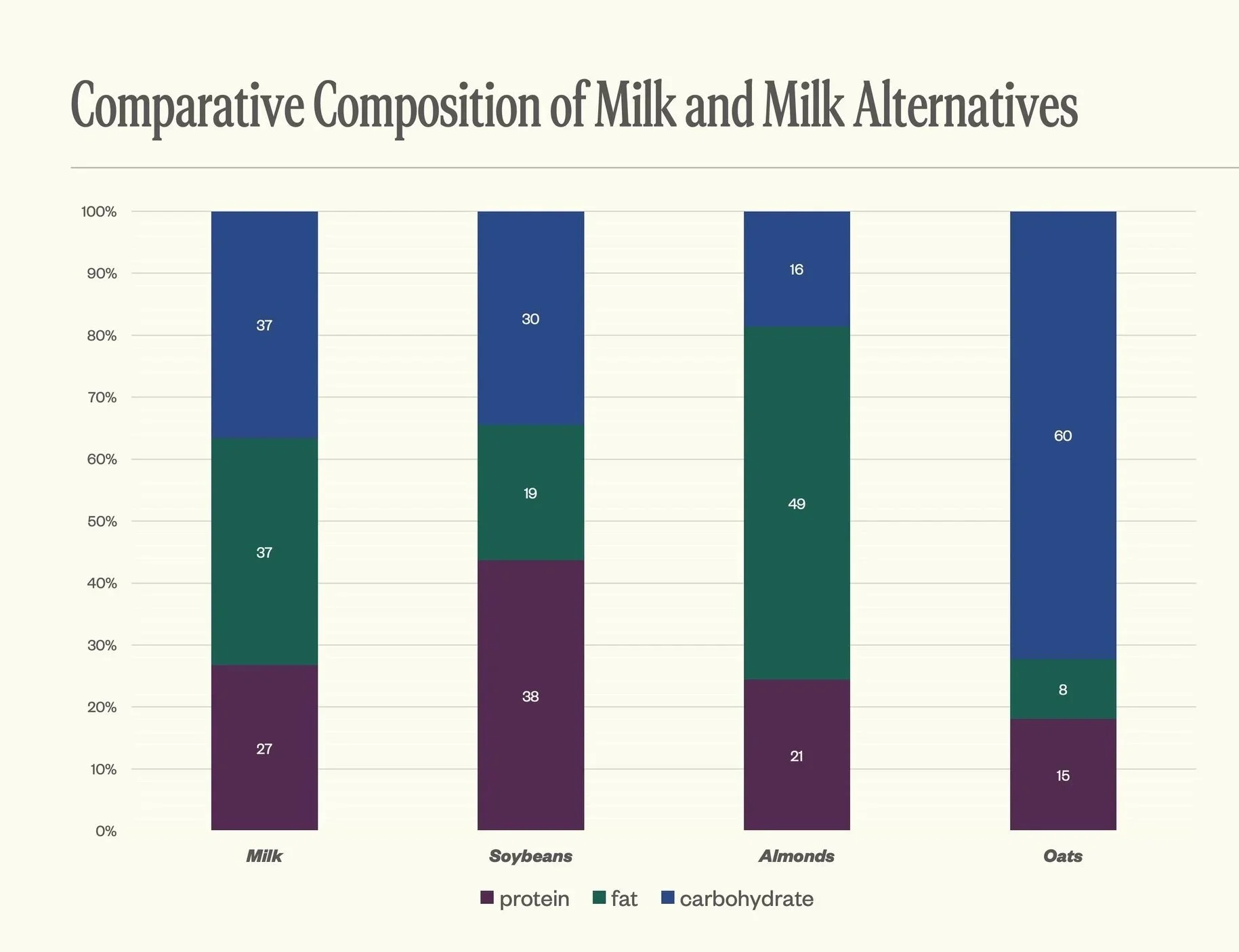
The good news is, each of these seeds has protein, fat, and carbohydrates. And all three create white, creamy milk-like liquid when steeped in water. The bad news is, none are a perfect substitute, for various reasons. But many of these reasons are fixable—at least to some extent. Let’s take each one, case by case.
Soybeans and Soy Milk
As you can see, soybeans are the closest to milk in terms of the balance between protein, fat, and carbohydrate. Furthermore, people in China have been making a delicious, milky drink from soybeans for hundreds of years. For these reasons, milk made from soybeans was an obvious early dairy substitute, enjoyed outside of China since at least the 1800s. Soy milk has slightly less fat than dairy milk, so sometimes extra fat in the form of vegetable oil is mixed in to increase the creaminess. Fortunately, soy oils are naturally emulsified, so homogenization isn’t necessary.
One issue with soy is a “beany” flavor that can emerge if the soy is heated in the presence of oxygen. This is not a bad thing if you’re drinking soy for soy’s sake, but some people feel it contrasts with coffee flavor. So, many soy milk manufacturers use oxygen-free environments to make their products, eliminating the beany taste.
Almonds and Almond Milk
Like soy drinks in China, almonds have been used to make drinks in the Middle East and Europe for hundreds of years. Almond milk is, even today, a common refreshment in Italy, Sicily, and France. The challenge in using almond milk for coffee is it has significantly more fat and less carbohydrate than dairy milk, and as we recall, fats (though delicious) are not great for foams. One solution is to use partially defatted almonds for milk making, which reduces the fat content. Another complementary solution is to use carrageenan—an extract of red seaweed—to supplement the foam structure and increase texture.[5] Finally, a bit of sugar is often added to almond milk to make it as sweet as dairy.
Oats and Oat Milk
The newest addition to our milk substitute options is oat milk. Oats have two issues: one, they produce a liquid with much less fat than milk, and two, the carbohydrates in oats tend to take on a jellylike or paste-like character when heated (think about the texture of oatmeal). In oat’s case, the answer is to use enzymes to break down these carbohydrates, making the milk sweeter and non-slimy. And, with the addition of vegetable fats and perhaps a bit of carrageenan, you can have a dairy substitute that is both delicious and frothy.
All of these vegetable milks need one more ingredient to taste like dairy: a little salt. All animal products have salt, but few vegetable products do. So, a bit of salt rounds out the flavor.
Whether milk or an alternative, baristas and consumers now have lots of options with which they can make beautiful, delicious foamy coffee beverages. And food science—the understanding of ingredients at the chemical level—helps make that possible.
References
[1] S.D. Kalyankar, C.D. Khedkar, A.M. Patil, S.S. Deosarkar, Milk: Sources and Composition, Editor(s): Benjamin Caballero, Paul M. Finglas, Fidel Toldrá, Encyclopedia of Food and Health, Academic Press, 2016,
[2] García MC, Torre M, Marina ML, Laborda F. Composition and characterization of soyabean and related products. Crit Rev Food Sci Nutr. 1997 Jun;37(4):361-91.
[3] Kalita, Soumik & Khandelwal, Shweta & Madan, Jagmeet & Pandya, Himanshu & Sesikeran, Boindala & Krishnaswamy, Kamala. (2018). Almonds and Cardiovascular Health: A Review. Nutrients. 10. 468
[4] Zhang, Kailong, Rui Dong, Xinzhong Hu, Changzhong Ren, and Yuwei Li. 2021. "Oat-Based Foods: Chemical Constituents, Glycemic Index, and the Effect of Processing" Foods 10, no. 6: 1304.
[5] McClements, David Julian, et al. “Plant-Based Milks: A Review of the Science Underpinning Their Design, Fabrication, and Performance.” Comprehensive Reviews in Food Science and Food Safety, vol. 18, no. 6, 2019, pp. 2047–2067
Learn More


DIVE DEEPER.
Researcher HELEN VAKIMA describes valuable research into the sensory characteristics and chemical and nutritional content of over 100 commercial plant-based beverages. What kind of attributes do you want your beverage to have? Using the map developed by the researchers of this study will help you narrow down the choices you might want to explore.
Create a free Associate Membership to read the article on the SCA Portal.
READ.
In last week’s Coffee Decoded, PETER GIULIANO shares some insights into the science behind dairy milk, and why it’s possible to create wonderful microfoam.
The National Coffee Association and SCA publish an annual Specialty Coffee Breakout Report about US coffee consumption trends, including patterns in milk consumption. Access the 2026 report free here.
WATCH.
Watch presentations from the 2026 World Barista Championships. All competitors must present milk or plant-based “milk” drinks and are judged on taste, technical skill, creativity, and presentation. This is a great way to see how the world’s best baristas are leveraging the latest science—including sometimes sharing blends of different types of “milk.”