

Welcome to Coffee, Decoded, the Specialty Coffee Association’s weekly column on science, research, and all things coffee knowledge. In Coffee Decoded we answer complex coffee questions, interpret new research, and dive deep into the science. I’m LAUREL CARMICHAEL, the Content Development Manager at the SCA and this week I’m stepping in for my colleague, Peter Giuliano.
Work with coffee long enough, and sooner or later you may have one of the strangest experiences in our industry: a dose of ground coffee that smells unmistakably like freshly-peeled raw potatoes. The smell is potent and it’s one of the most distinctive aromas in the coffee world. Unfortunately, it can also be somewhat unpleasant.
This distinctive smell is Potato Taste Defect (PTD), often known simply as “potato defect.” It’s found only in coffees from some East African countries, including Rwanda, Burundi, Uganda, and the DR Congo. The smell has a particularly low odor detection threshold, which means that it’s especially easy for humans to pick up. This is helpful, as it doesn’t take a huge amount of training to spot it, but challenging, because customers might smell or taste it in their coffee too. The smell is usually only noticeable once the coffee is ground and it lingers in the air for a long time, so it can be difficult to find the specific source—was there a single impacted bean in that espresso shot, or in the batch brew? Does this coffee truly have PTD, or is it just grassy and herbaceous?
But what causes PTD? How can coffee smell so realistically like raw potato? The science isn’t completely settled yet, but today we’ll dig into the leading theories.
The Chemistry Behind PTD
PTD has been linked to two chemical compounds: 2-isopropyl-3-methoxypyrazine (IPMP) and 2-isobutyl-3-methoxypyrazine (IBMP).[1] They belong to a family of compounds known for vegetable-like aromas and extremely low detection thresholds. IPMP shows up elsewhere in the food world, too: it’s associated with something known “ladybug taint” in wine, where the presence of a type of beetle is linked to a strong, bell pepper–like aroma on the grapes.[2] So how do these compounds end up in coffee?
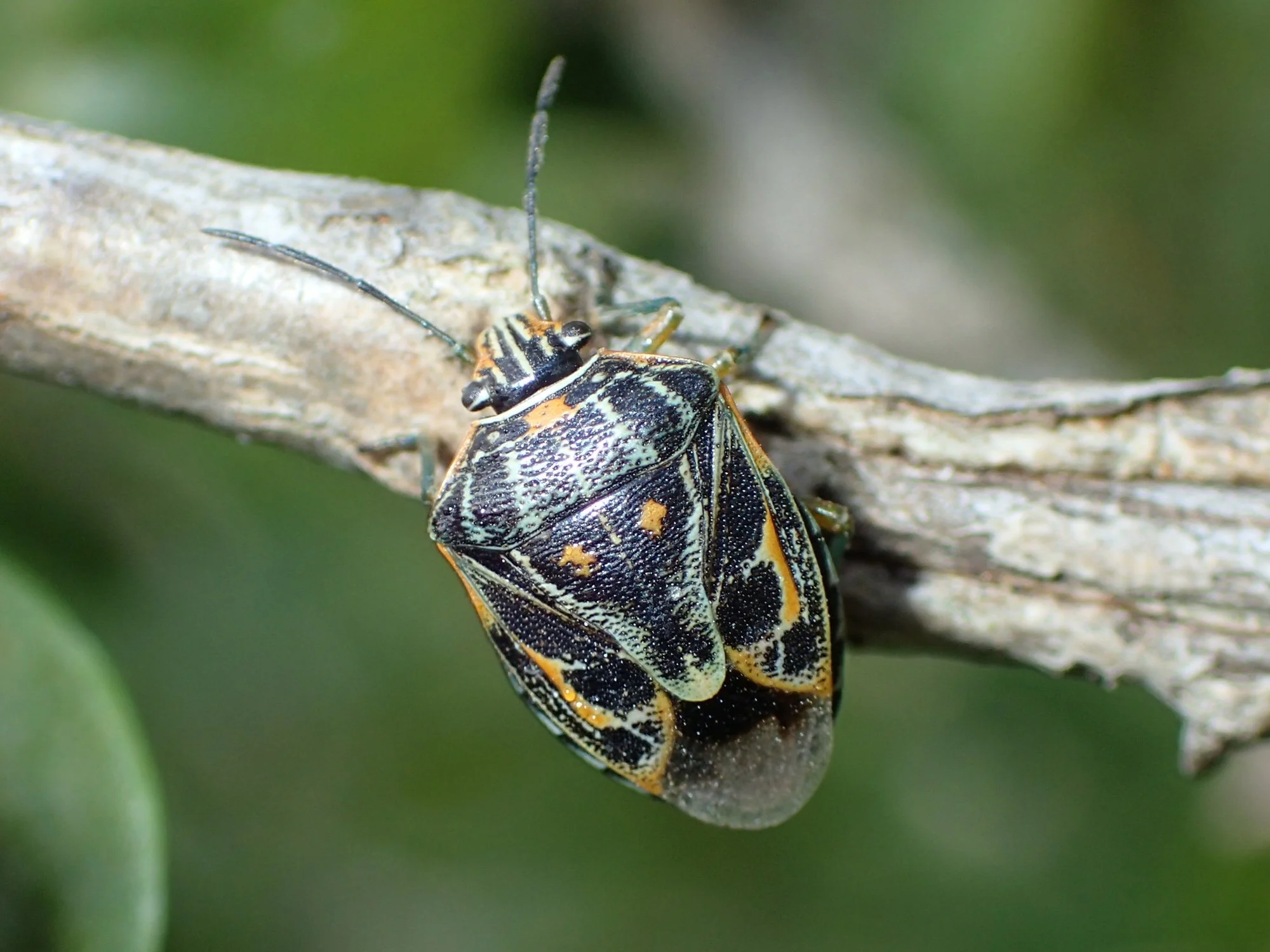
An antestia bug, identifiable by its shield-like wings and variegated color. Source: Wikipedia Commons
Is Potato Taste Defect Caused by Bugs?
For several years, scientists have associated PTD with a genus of bugs known as Antestiopsis, often referred to simply as the antestia bug. These bugs, which are native to sub-Saharan Africa feed on various parts of the coffee plant, including the cherries at different stages of ripeness.3 When the bugs feed on the coffee plant they leave pin-prick like holes which allows the bacteria Pantoea coffeiphila to enter the cherry. It’s this bacteria, which translates as “coffee loving bacteria from many places,” that, many scientists believe, leads to the creation of those two potato-smelling compounds, IPMP and IBMP.
However, researchers still debate exactly how this process of bacterial infection and flavor change happens, and are investigating other potential causes of PTD.
Causes Other Than Bugs?
In 2025, Joseph Bigirimana and a group of researchers at the Rubona Agricultural Research Centre in Rwanda conducted a study to evaluate whether there is a direct relationship between damage caused by the antestia bug and the occurrence of PTD.[3] Could the defect arise in other ways, like mechanical damage during harvest or processing? In a controlled experiment, they compared three groups of coffee cherries: some damaged only by antestia bugs, some pierced with a needle to simulate bug damage, and an undamaged control group.
The needle-pierced cherries had the highest levels of IPMP. In other words, the bug itself isn’t essential to producing PTD; other entry points for the bacteria are possible. But, in coffee farms, the antestia bug is still by far the most likely cause of that kind of pinprick-shaped damage, so the researchers concluded that pest control remains the best way to manage the defect.
In Summary
So, what have we learned? Potato defect comes down to two powerful compounds, likely caused by bacteria in damaged coffee cherry, and the antestia bug is the usual culprit. Research like the 2025 Rwandan study is building a fuller picture of the defect and how to prevent it. For now, if you encounter coffee that smells like potatoes, don’t panic, dispose of the dose (ideally in a container with a lid to trap the odor) and move on!
References
[1] World Coffee Research, Potato Taste Defect, Impacts of the Anestia bug and overview of mitgation efforts, 2023, https://worldcoffeeresearch.org/resources/potato-taste-defect.
[2] GJ Pickering, A. Botezatu, “A Review of Ladybug Taint in Wine: Origins, Prevention, and Remediation,” Molecules, 2021, https://doi.org/10.3390/molecules26144341.
[3] Joseph Bigirimana, et al., “Mechanical Damage Causes Potato Taste Defect in Coffee Without Antestia Bug Infestations: Evidence from Experimental Data,” International Journal of Fruit Science, 2025, https://doi.org/10.1080/15538362.2025.2548292.
Learn More
HOW TO ASSESS PTD IN CUPPINGS.
Because PTD manifests primarily as a sensory defect (rather than a visible, physical defect), it is recorded in the Coffee Value Assessment Affective Assesment. You can learn more about this protocol in the Affective Assessment standard, under “Defects and Uniformity.”
READ.
A review of scientific understandings of PTD, published by World Coffee Research in 2023.

Coffee with Carly explains Potato Taste Defect from the perspective of, well… a potato.