

Coffee Decoded: The Challenge of Flavor Chemistry in Coffee
Welcome to Coffee, Decoded, the Specialty Coffee Association’s weekly column on science, research, and all things coffee knowledge. Each week, PETER GIULIANO answers complex coffee questions, interprets new research, and dives deep into the science, putting it all in a fun, understandable format.
At some point, most coffee people become fascinated by the chemistry behind our favorite drink. After we learn to love the sweetness of a high-quality Colombian coffee or the floral nature of an elegant Ethiopian one, we naturally want to know what’s behind these flavors.
“Flavor” is the key word here. Sensory scientists have long defined flavor as a perception that combines taste and smell. These two senses are known as the chemical senses: they are the way our bodies perceive the chemical makeup of our environment. They do so in different ways: the taste buds in our tongues detect solid or liquid chemicals, and the olfactory receptors in our noses detect volatile chemicals, those chemicals that float on the air. The result of the brain combining these two sophisticated chemical detection systems results in a mental experience of flavor—what I call the “flavor image.”
Since these nonvolatile and volatile chemicals exist in the world, we should be able to measure them. And indeed we can. Chemists have, for the past 200 years, devised many ways to measure chemicals, including those compounds that create coffee’s flavors. These methods are extremely accurate and can detect the thousands of chemicals in a sample of coffee.
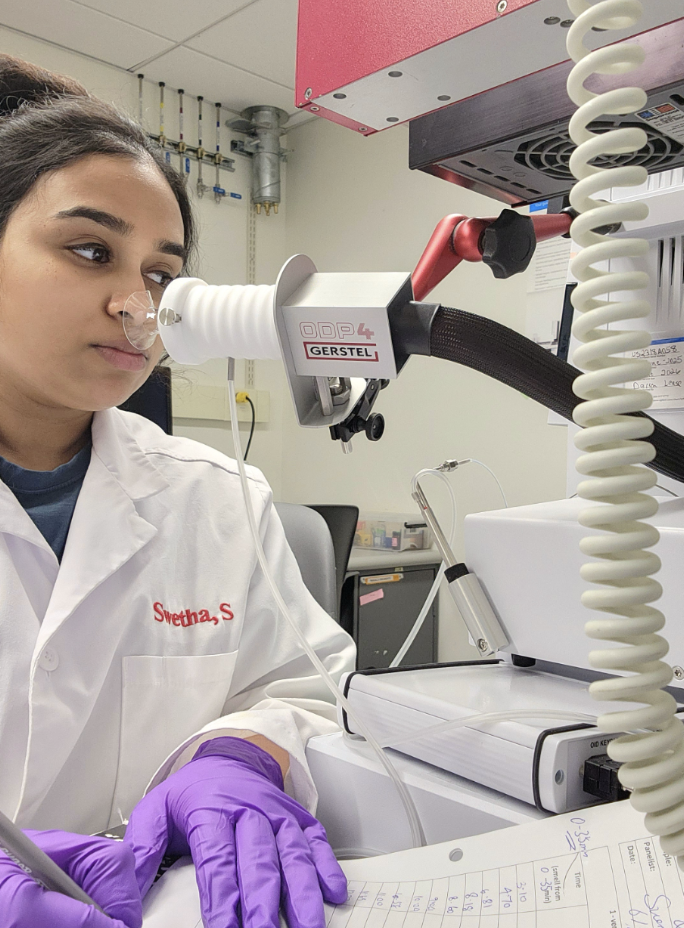
Coffee researcher Swetha Sarangarajan of the Ohio State University’s Flavor Research and Education Center evaluating coffee aromatic compounds.
But how do we know how these compounds taste or smell? Early chemists behaved more or less like curious children: when they discovered a new compound they would often just smell or taste a bit of it. This was how pioneer chemist Carl Wilhelm Scheele[1] did things—this is how he discovered citric acid. Unfortunately, just a year later, he died from poisoning after tasting his own experiments, which often contained mercury, chlorine, and lead.
Chemists are much more cautious these days, but there is still no replacing human sensation when detecting the smells and tastes of compounds. One method, called Gas Chromatography-Olfactometry, is especially useful: a researcher stands at a sophisticated machine that can separate, identify, and quantify volatile compounds in a sample. The machine then sends a bit of the gassy compound up a tube called an “olfaction port” where the operator can smell it. If the stuff has a smell, the operator can identify it: “it smells like roses” or “it smells like caramel.”
Coffee researchers are doing exactly this right now. At the Ohio State University, for example, researchers supported by the Coffee Science Foundation are using this technique to identify sweet-smelling compounds in coffee. Some of these compounds are known—like fruity esters in naturally processed coffees—but others are previously unknown. This latter category is especially exciting; we might discover a new compound that leads to sweet smelling coffees! Researchers at the Coffee Excellence Center near Zürich also used this technique to smell odor compounds associated with green coffee defects, as part of research to understand the impact of these defects on the cup.[2]
Another technique, used to identify taste, is called “sensory guided fractionation.” A beverage like coffee is divided into chemical “fractions” which are then tasted. Once a taste is identified, the fraction is further divided, until eventually the researcher identifies specific compounds. This was exactly how researchers, again at Ohio State, discovered compounds in coffee that create coffee’s mouthfeel.[3]
As you might imagine, the sheer complexity of flavor chemistry is a major obstacle: a food like coffee has thousands of compounds which interact in complex ways to create flavor. Researchers are now using new, sophisticated data analysis tools called “Flavoromics” to intelligently detect patterns in food chemistry and flavor. This third technique holds a tremendous amount of promise in discovering and understanding coffee flavors in the future.
Understanding flavor chemistry isn’t easy, but it’s worth it—it's how we can further understand the magic of coffee’s flavor and use that knowledge to make coffee better.
- PETER GIULIANO is the SCA's Senior Advisor for Scientific Communication.
References:
[1] Scheele is also often credited with discovering oxygen, which he called “fire air,” although Joseph Priestley published his findings first.
[2] Laurel Carmichael, “Grounding Green Grading in Sensory Science: Research to Understand Physical Coffee Defects,” 25, Issue 24, 2025, https://sca.coffee/sca-news/25/issue-24-grounding-green-grading.
[3] Brianne Linne, "Identification and Characterization of Chemical Compounds Contributing to Coffee Body," Doctoral dissertation, Ohio State University, 2022.
Want to learn more?
Read
Grounding Green Grading in Sensory Science
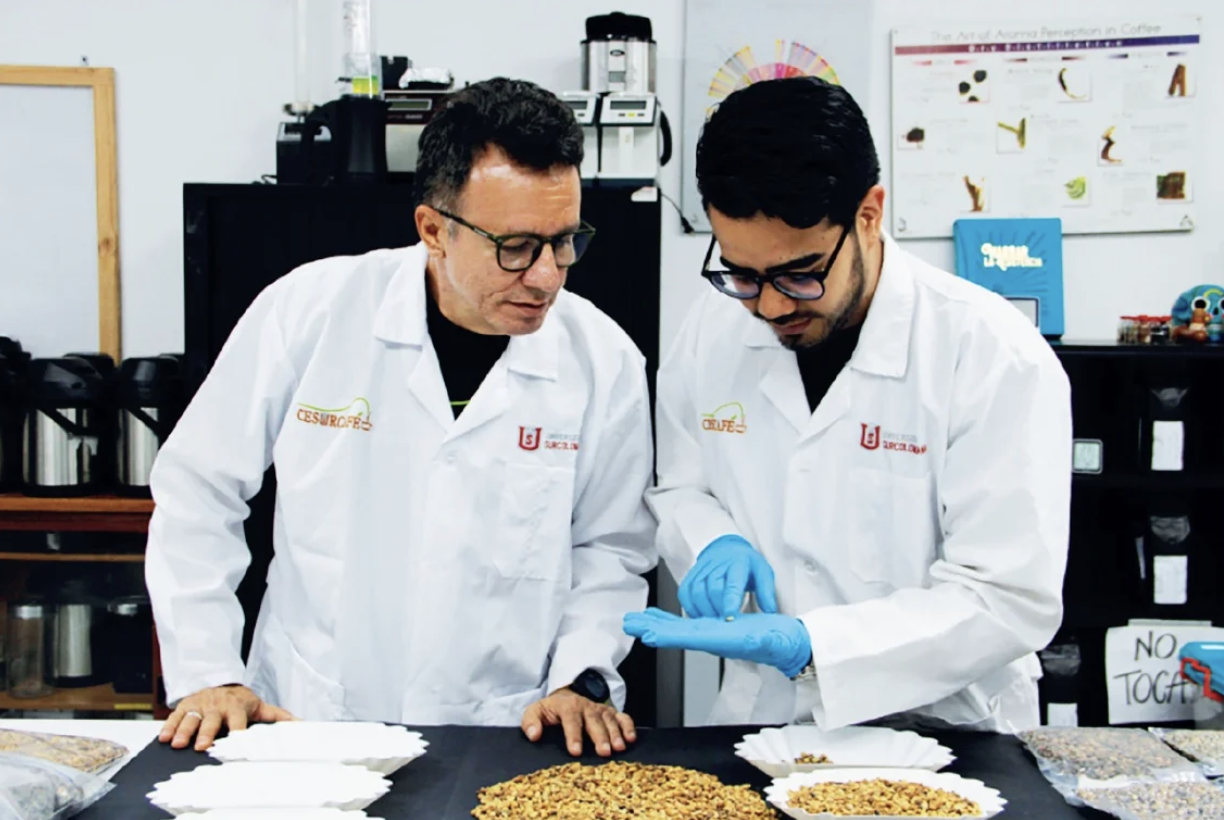
In 25, Issue 24, LAUREL CARMICHAEL, introduces a Coffee Science Foundation research project on the sensory impact of physical defects in green coffee, undertaken at the Coffee Excellence Center at the Zurich University of Applied Sciences. Accessible via the SCA Member Portal.
How Sweet Coffee Tastes! Towards an Understanding of Coffee Sweetness

In 25, Issue 22, Dr. NANCY CORDOBA and Dr. DEVIN PETERSON, joined by PETER GIULIANO, share early results of a multi-year Coffee Science Foundation research project, undertaken at the Flavor Research and Education Center at Ohio State University, to establish foundational knowledge about the phenomenon of sweetness in coffee. Accessible via the SCA Member Portal.
Watch
Sweetness in Coffee: Sensory Analysis and Identification of Key Compounds | Dr. Nancy Cordoba
Dr. Nancy Cordoba speaks at Re:co Symposium about a mystery among coffee experts and sensory scientists—if sugars do not make coffee taste sweet, what could be the reason for the sweet taste of high-quality coffee