

Coffee Decoded: How Much Coffee Does It Take To Make Coffee?
Welcome to Coffee, Decoded, the Specialty Coffee Association’s weekly column on science, research, and all things coffee knowledge. Each week, PETER GIULIANO answers complex coffee questions, interprets new research, and dives deep into the science, putting it all in a fun, understandable format.
How much coffee does it take to make coffee?
The title seems preposterous, but the point is this: when a person plucks a cherry from the coffee tree, they hold in their fingers a little bit of what will eventually become a coffee beverage. But how much? I mean, not all of that fruit will become the roasted, brewed drink we know as “coffee”; just some of it. So how much of that coffee cherry actually becomes drinkable coffee? Well, that’s an interesting question. Let’s get into it.
First of all, the coffee plant, like all plants, ingests carbon dioxide, water, sunlight, and nutrients from the soil to flourish and make copies of itself. Through the magic of photosynthesis and respiration, the coffee plant grows new tissues, including leaves, stems, and fruit. (This process uses mostly carbon dioxide from the air, which is why plants are so good at accumulating carbon. This is amazing, however: a plant is mostly made of air). The plant’s fruit contains a seed, and that seed is what we use to make coffee. But it’s not that simple. Once picked, there are several processes designed to get that seed to a form where it can be brewed, and once there, we use water to get that coffee-seed flavor into a beverage we can drink. Most of these methods mean getting rid of byproducts- that coffee-stuff that we don’t drink. And it turns out the entire process is pretty wasteful: most of the coffee fruit is left behind as byproducts. How much?
Take a guess: I’ll reveal the answer in a minute.
Luckily, we have some high-quality research in this area. International Agriculture researcher Neal Rotta and his colleagues did a study combining data from farms and mills in Latin America, along with coffee roasteries and laboratories in the United States. The result is an interesting picture of how “mass flow”—how material is kept or lost in a process—works in coffee.
The first step in coffee-processing is harvesting, when the coffee fruit is removed from the plant. Most specialty coffee is harvested by hand, which is relatively gentle, but still a little foreign matter (like stems and leaves) is discarded, about 1 % of the mass. The rest moves on to processing. Most specialty coffee is processed by the “washed” method, the first step of which is removing the coffee “pulp”—that layer of skin which protects the coffee. This pulp is the biggest waste stream in coffee. During this step, about 47 % of the mass of the coffee is discarded. Next comes fermentation and washing, in which the sticky “mucilage” layer is broken down and washed away. This accounts for another 5 % of mass loss. The coffee is then ready to be dried.
Drying is another important process. Most of the water the plant has absorbed through its roots must now be removed from the seed, otherwise it would germinate or spoil. Water is pretty heavy, so during drying coffee loses about 21 % of its mass as water vapor into the air. Coffee at this stage still has its “parchment” shell, which must be removed. Doing this removes another 6 % or so of the coffee’s mass. Specialty coffee is usually sorted for export, which means more loss: another five percent on average is discarded as defects or non-export quality coffee. The coffee is now dried “green coffee” ready for export-and it has already lost over 80 % of the mass from the harvested fruit. And we’re not done yet.
The green coffee is then shipped to a roaster, who proceeds to heat the coffee to improve its flavor. Though the coffee is mostly dry—it has a little more water to lose at this point, along with some carbon dioxide and a bit of chaff. All in all, it represents a loss of about 2 % of the original fruit mass. Then the coffee goes to the coffee maker—the barista or consumer—who grinds it and uses water to extract the flavorful soluble material. The spent “grounds” are then discarded: throwing away another 10 % of the coffee’s original mass.
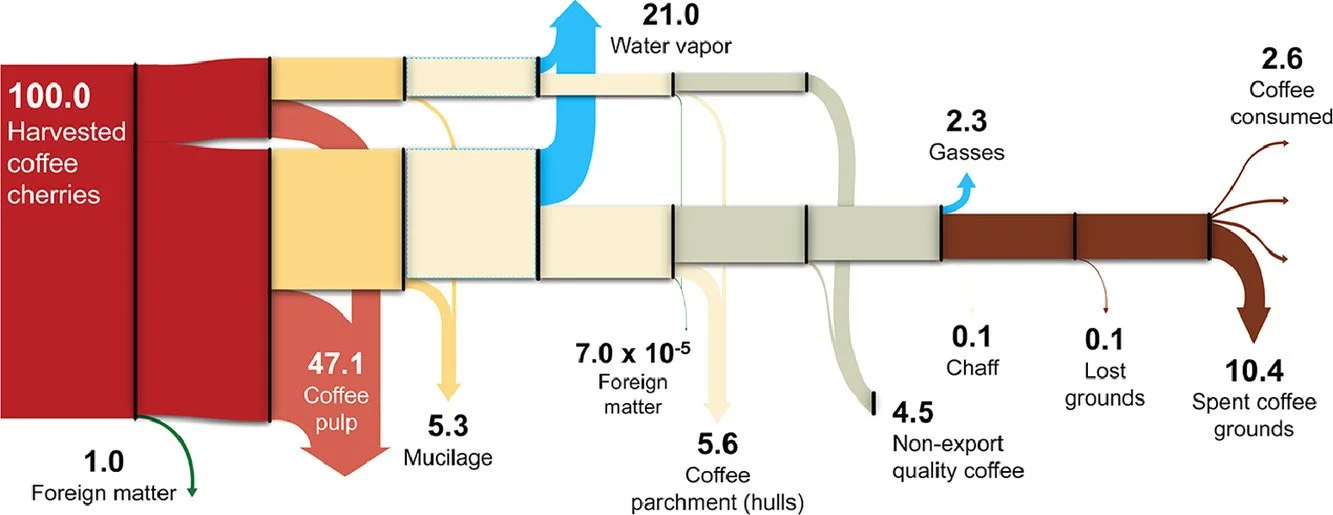
A chart showing “mass flow” in the coffee value chain. Loss of mass occurs from coffee’s harvesting to the point of its consumption—where only 2.6 % of coffee’s original mass is consumed. Graphic from Neil M. Rotta, Stephen Curry, Juliet Han, Rommel Reconco, Edward Spang, William Ristenpart, Irwin R. Donis-González, “
A comprehensive analysis of operations and mass flows in postharvest processing of washed coffee,” Resources, Conservation and Recycling 170, 2021, https://doi.org/10.1016/j.resconrec.2021.105554.
We have now got our cup of coffee. About how much of the original coffee fruit’s mass is in your cup? According to the best accounting of the process, the answer is an astonishingly low 2.6 %. It’s true: during harvesting, processing, milling, roasting, and brewing, more than 97 % of the coffee’s original mass is lost as byproducts or waste.
For this reason, farmers, processors, researchers, and sustainability experts are constantly looking for ways to make better use of coffee byproducts. Much is used to make compost or animal feed, but what else can be done? I’ve heard of alternative beverages, firelogs, paper, biofuel, nutritional supplements, and synthetic leather made from coffee byproducts. But there is plenty of opportunity here: what uses have you heard of for coffee waste?
- PETER GIULIANO the SCA's Senior Advisor for Scientific Communication.
Want to learn more?
Read the Academic Paper
Rotta et al., “A comprehensive analysis of operations and mass flows in postharvest processing of washed coffee,” 2021, https://doi.org/10.1016/j.resconrec.2021.105554.
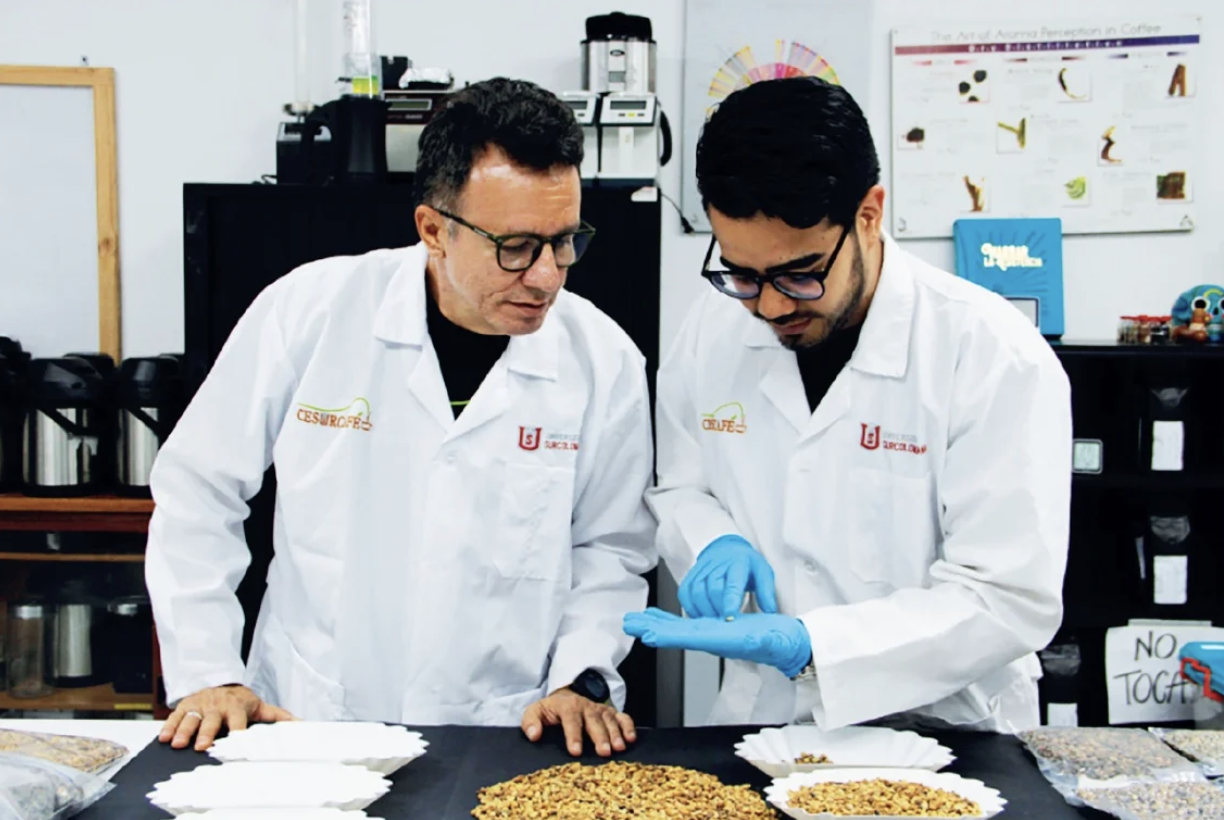
Learn About Recent Coffee Science Foundation Research on Physical Defects in Coffee
Laurel Carmichael, “Grounding Green Grading in Sensory Science,” 25, Issue 24, 2025, https://specialtycoffee.my.site.com/s/magazine-detail-page?recordId=a3nVw000000ox3JIAQ.

Want to learn more about uses for coffee waste products?
Watch a Webinar on Circular Economy in Coffee with SCA Sustainability Manager and Doughnut Economics Lab. https://youtu.be/kREHlB7yOAg?si=Q6ak93UuWs3oIFi-